viernes, 8 de noviembre de 2019

November 10, 2019

______________________________________________________________________________
Kudos
_____________________________________________________________________________________________________
  • Thank you to EVERYONE for a great first term of the 2019-2020 school year!  Can you believe we are 1/4 through this year?  I can't... going so fast!  Thank you for the strong relationships you have developed with our students and for the unwavering focus on academics and character education!  
  • Thank you for stepping up and donating for United Way!!!  It was fun coming around to your rooms offering baked goods, coffee, or hot chocolate!  As a staff we raised 330 dollars during our little snack and beverage time!  Thank you all for your generous donations!!!  And... we learned a lot about people's preferences along the way as well!!!  The lemon poppyseed is a popular one and more people drink coffee black than we thought!  Thanks again!!!  
  • Thank you to BLT for your time during our meeting this week.  BLT worked hard analyzing our Forward data and coming up with some key take aways that we will examine further on Wednesday during our inservice time in the library.  Thank you again for your commitment to our work!  
Article this week:  

As Diversity Grows, So Must We

Gary R. Howard
Schools that experience rapid demographic shifts can meet the challenge by implementing five phases of professional development.
Many school districts nationwide are experiencing rapid growth in the number of students of color, culturally and linguistically diverse students, and students from low-income families. From my work with education leaders in some of these diversity-enhanced school districts, I know they are places of vibrant opportunity—places that call us to meaningful and exciting work. In these “welcome-to-America” schools, the global community shows up in our classrooms every day, inviting us—even requiring us—to grow as we learn from and with our students and their families.

The Need for Growth

All is not well, however, in these rapidly transitioning schools. Some teachers, administrators, and parents view their schools' increasing diversity as a problem rather than an opportunity. For example, in a school district on the West Coast where the number of Latino students has quadrupled in the past 10 years, a teacher recently asked me, “Why are they sending these kids to our school?” In another district outside New York City—where the student population was once predominantly rich, white, and Jewish but is now about 90 percent low-income kids of color, mostly from the Caribbean and Latin America—a principal remarked in one workshop, “These kids don't value education, and their parents aren't helping either. They don't seem to care about their children's future.” In a school district near Minneapolis with a rapidly increasing black population, a white parent remarked, “Students who are coming here now don't have much respect for authority. That's why we have so many discipline problems.”

Other educators and parents, although less negative, still feel uneasy about their schools' new demographics. In a high school outside Washington, D.C., where the Latino immigrant population is increasing rapidly, a teacher told me that he was disappointed in himself for not feeling comfortable engaging his students in a discussion of immigration issues, a hot topic in the community in spring 2006. “I knew the kids needed to talk, but I just couldn't go there.” And a black teacher who taught French successfully for many years in predominantly white suburban schools told me recently, “When I first found myself teaching classes of mostly black kids, I went home frustrated every night because I knew I wasn't getting through to them, and they were giving me a hard time. It only started getting better when I finally figured out that I had to reexamine everything I was doing.”
This teacher has it right. As educators in rapidly transitioning schools, we need to reexamine everything we're doing. Continuing with business as usual will mean failure or mediocrity for too many of our students, as the data related to racial, cultural, linguistic, and economic achievement gaps demonstrate (National Center for Education Statistics, 2005). Rapidly changing demographics demand that we engage in a vigorous, ongoing, and systemic process of professional development to prepare all educators in the school to function effectively in a highly diverse environment.
Many education leaders in diversity-enhanced schools are moving beyond blame and befuddlement and working to transform themselves and their schools to serve all their students well. From observing and collaborating with them, I have learned that this transformative work proceeds best in five phases: (1) building trust, (2) engaging personal culture, (3) confronting issues of social dominance and social justice, (4) transforming instructional practices, and (5) engaging the entire school community.

Phase 1 and 2 were in the blog last week!!!!  

Phase 3: Confronting Social Dominance and Social Justice

When we look at school outcome data, the history of racism, classism, and exclusion in the United States stares us in the face. Systems of privilege and preference often create enclaves of exclusivity in schools, in which certain demographic groups are served well while others languish in failure or mediocrity. As diversity grows in rapidly transitioning school districts, demographic gaps become increasingly apparent.
In phase three, educators directly confront the current and historical inequities that affect education. The central purpose of this phase is to construct a compelling narrative of social justice that will inform, inspire, and sustain educators in their work, without falling into the rhetoric of shame and blame. School leaders and teachers engage in a lively conversation about race, class, gender, sexual orientation, immigration, and other dimensions of diversity and social dominance. David Koyama, principal of a diversity-enhanced elementary school outside Seattle, said, “One of my most important functions as a school leader is to transform political jargon like ‘no child left behind’ into a moral imperative that inspires teachers to work toward justice, not mere compliance.”
Unraveling social dominance takes courage—the kind of courage shown by the central office and school leadership team in the Roseville Area School District outside the twin cities of Minneapolis and St. Paul. Roseville is in the midst of a rapid demographic shift. As we approached this phase of the work, I asked Roseville leaders to examine how issues of privilege, power, and dominance might be functioning in their schools to shape educators' assumptions and beliefs about students and create inequitable outcomes.
One of the workshop activities engaged participants in a forced-choice simulation requiring them to choose which aspects of their identity they would give up or deny for the sake of personal survival in a hostile environment. Choosing from such identities as race, ethnicity, language, religion, values, and vocation, many white educators were quick to give up race. Among the Roseville administrative team, which is 95 percent white, the one white principal who chose to keep his racial identity during the simulation said during the debriefing discussion, “I seriously challenge my white colleagues who so easily gave up their race. I think if we are honest with ourselves, few would choose to lose the privilege and power that come with being white in the United States.”
As an outgrowth of the authentic and sometimes contentious conversations that emerged from this and other activities, several core leaders and the superintendent identified a need to craft a strong Equity Vision statement for the district. The Equity Vision now headlines all opening-of-school events each year and is publicly displayed in district offices and schools. It reads,
Roseville Area Schools is committed to ensuring an equitable and respectful educational experience for every student, family, and staff member, regardless of race, gender, sexual orientation, socioeconomic status, ability, home or first language, religion, national origin, or age.
As a result of the increased consciousness about issues of dominance and social justice, several schools have formed Equity Teams of teachers and students, and an Equity Parent Group has begun to meet. The district is looking seriously at how many students from dominant and subordinate groups are in its gifted and AP classes and is conscientiously working for more balance.
Like Roseville, other diversity-enhanced districts must establish clear public markers that unambiguously state, “This is who we are, this is what we believe, and this is what we will do.” Any approach to school reform that does not honestly engage issues of power, privilege, and social dominance is naïve, ungrounded in history, and unlikely to yield the deep changes needed to make schools more inclusive and equitable.

Phase 4: Transforming Instructional Practices

In this phase, schools assess and, where necessary, transform the way they carry out instruction to become more responsive to diversity. For teachers, this means examining pedagogy and curriculum, as well as expectations and interaction patterns with students. It means looking honestly at outcome data and creating new strategies designed to serve the students whom current instruction is not reaching. For school leaders, this often means facing the limits of their own knowledge and skills and becoming colearners with teachers to find ways to transform classroom practices.
In Loudoun County Public Schools, outside Washington, D.C., teachers and school leaders are taking this work seriously. One of the fastest-growing school systems in the United States, Loudoun County is experiencing rapid increases in racial, cultural, linguistic, and economic diversity on its eastern edge, closer to the city, while remaining more monocultural to the west. Six of Loudoun's most diverse schools have formed leadership teams to promote the following essential elements of culturally responsive teaching (CRT):
  • Forming authentic and caring relationships with students.
  • Using curriculum that honors each student's culture and life experience.
  • Shifting instructional strategies to meet the diverse learning needs of students.
  • Communicating respect for each student's intelligence.
  • Holding consistent and high expectations for all learners. (Gay, 2000; Ladson-Billings, 1994; McKinley, 2005; Shade, Kelly, & Oberg, 1997)
CRT teams vary in size and membership but usually include principals, assistant principals, counselors, lead teachers, specialists, and, in some cases, parents. In addition to engaging deeply in the phases outlined above, these teams have begun to work with their broader school faculties to transform instruction. At Loudoun County's Sugarland Elementary, teacher members of the CRT team have designed student-based action research projects. They selected individual students from their most academically challenged demographic groups and then used the principles of CRT to plan new interventions to engage these students and track their progress.
In one action research project, a 5th grade teacher focused on a Latino student, an English language learner who “couldn't put two sentences together, let alone write the five-paragraph essay that is required to pass our 5th grade assessment.” The teacher's first reaction was to ask, “How was this student allowed to slip by all these years without learning anything beyond 2nd grade writing skills?” When the teacher launched her CRT project, however, her perspective became more proactive. She realized that she couldn't just deliver the 5th grade curriculum—she had to meet this student where he was. She built a personal connection with the student, learned about his family culture and interests (a fascination with monkeys was a major access point), and used this relationship to reinforce his academic development. The student responded to her high expectations and passed his 5th grade writing assessment. And after missing its No Child Left Behind compliance goals in past years, Sugarland recently achieved adequate yearly progress for all subgroups in its highly diverse student population.
This phase requires a crucial paradigm shift, in which teachers and other school professionals stop blaming students and their families for gaps in academic achievement. Instead of pointing fingers, educators in Loudoun schools are placing their energies where they will have the most impact—in changing their own attitudes, beliefs, expectations, and practices. I frequently ask teachers and school leaders, “Of all the many factors that determine school success for our students, where can we as educators have the most influence?” After educators participate in the work outlined here, the answer is always, “Changing ourselves.”

Phase 5: Engaging the Entire School Community

Changing demographics have profound implications for all levels and functions of the school system. To create welcoming and equitable learning environments for diverse students and their families, school leaders must engage the entire school community.
Leaders in the East Ramapo Central School District in New York State have committed themselves to just such a systemwide initiative. The school district, which lies across the Tappan Zee Bridge from New York City, has experienced a dramatic shift in student population in the past 15 years as low-income Haitian, Jamaican, Dominican, Latino, and black families from the city have moved into the community and middle-class white families have, unfortunately but predictably, fled to private schools or other less diverse districts.
In the midst of this demographic revolution, East Ramapo's broad-based diversity initiative has engaged all groups and constituencies in the school district community, not just teachers and administrators. For example, the district has provided workshops to help classified employees acknowledge their powerful role in setting a welcoming tone and creating an inclusive climate for students, parents, and colleagues in school offices, lunchrooms, hallways, and on the playground. For bus drivers, this work has meant gaining cultural competence skills for managing their immense safety responsibilities while communicating clearly and compassionately across many languages and cultures on their buses.
In one session that I led with school secretaries, we worked through their confusion and frustration related to all the diverse languages being spoken in the school offices and, in some cases, their feelings of anger and resentment about the demographic changes that had taken place in “their” schools. Asked what they learned from the session, participants commented, “I saw the frustration people can have, especially if they are from another country.” “We all basically have the same feelings about family, pride in our culture, and the importance of getting along.” “I learned from white people that they can also sometimes feel like a minority.”
In addition to these sessions, East Ramapo has created learning opportunities for school board members, parents, students, counselors, and special education classroom assistants. The district has convened regular community forums focusing on student achievement and creating conversations across many diverse cultures. White parents who have kept their children in the public schools because they see the value of diversity in their education have been significant participants in these conversations.
As a result of East Ramapo's efforts, the achievement gaps in test scores along ethnic and economic lines have significantly narrowed. In the six years since the district consciously began implementing the professional development model discussed here, the pass rate for black and Hispanic students combined on the New York State elementary language arts test increased from 43 percent in 2000 to 54 percent in 2006; on the math test, the pass rate increased from 40 percent to 61 percent. During that same period, the gap between black and Hispanic students (combined) and white and Asian students (combined) decreased by 6 percentage points in language arts and 23 percentage points in math. The achievement gap between low-income elementary students and the general population decreased by 10 points in language arts and 6 points in math—results that are particularly impressive, given that the proportion of economically disadvantaged students grew from 51 percent in 2000 to 72 percent in 2006.

A Journey Toward Awareness

Professional development for creating inclusive, equitable, and excellent schools is a long-term process. The school districts described here are at various stages in the process. Everyone involved would agree that the work is messier and more complex than can be communicated in this brief overview. However, one central leadership commitment is clear in all of these rapidly transitioning districts: When diversity comes to town, we are all challenged to grow.

______________________________________________________________________________
Information/Reminders
__________________________________________________________________________________________________________________________
  • Monday, November 11 - During Extended Advisory all 8th grade advisories please bring your students up to the auditorium ASAP after announcements and attendance.  Stephanie Rummler and Jack Schmidt worked to secure a Veteran, Sergeant Riggle, to come and bring awareness to our students. 
    • Sergeant Riggle is the father of sophomore Lillian Riggle who is at BHS.   
  • Monday, November 11 - Staff meeting in the library from 2:40 - 3:00.  EVERYONE is encouraged to attend!!! 
  • Monday, November 11 - District Essential Skills Committee meeting in our Karcher library from 3:45 - 5:15.  
  • Tuesday, November 12 - Onyx House field trip to the Field Museum in Chicago!  
    • Questions... see Katherine Botsford.  
  • Tuesday, November 12 - Special Education Department meeting from 2:40 - 3:15 in the small conference room.  
  • Wednesday, November 13 - full day inservice from 8-4.  
    • At 8:00 we will start in the library were we will analyze our Forward data, drilling down to the standards our student's excelled at and which standards we need to leverage and adjust when it comes to our curriculum and instruction.  All staff please come to the library as our student data is something we all own and need to know and be mindful of so we all can see where our gaps are and work to infuse into all of our classrooms.  
    • Then you will have time to work on your Essential Skills in your classrooms, infusing what we just learned along with continuing with the work you have been doing.  
    • At 11:30 it will be PURGE time!  As we all know, we will be moving into an amazingly awesome new building but with that comes the "right sizing" of the building as well.  As you know we are in a HUGE building, more space that what is needed.  With that comes the natural sprawl and stock piling of everything and anything!  We will have dumpsters and carts for you to use in order to start the process to down size!  
    • 12:00 - 4:00 
      • Lunch on your own and teacher work time!  However you see using that time!  
      • Thank you to everyone who have submitted their SLOs and PPGs.  I have been reviewing them and I am impressed with the focus around our Big Three and seriousness you are taking with your SLOs and PPGs.  If you have not submitted yet this would be a great time to use to do so!  
  • Thursday, November 14 - Staff Salad Luncheon!!!  
    • Thank you Kim for getting this on the calendar!  There is a signup in the main office by all of your mailboxes.  
  • Thursday, November 14 - Was going to be team sport pictures but there is a delay in the arrival of our basketball uniforms.  We will be moving this date but prior to setting it we are working to get a confirmation date for the uniforms!  
  • Friday, November 15 - Diamond House field trip to the Field Museum in Chicago!  
    • Questions... see Brad Ferstenou. 
Looking ahead:  
  • Monday, November 18 - 7th grade incentive time during extended advisory!  See the Google Documents shared from Andrea Hancock for more details!  
  • Tuesday, November 19 - Parent/Guardian/Teacher Conferences from 4:00 - 7:00. 
    • These are open conferences in your classrooms.  Please have chairs outside your room for people to use in the event they need to wait.  
    • Also... please position yourself in your room where you do have the ability to see if you have a line forming so that no one is waiting to long.  Parents/Guardians have been giving this information and we shared that time with one teacher should be 5 - 10 minutes max.  Be mindful of this!!! 
    • Also... the expectation is that all staff are ready and in your rooms by 3:45 so that we are professional and ready to meet our parents/guardians on time.  
  • Thursday, November 21 - Orchestra Concert at 7:00pm!  
    ______________________________________________________________________________
    Pictures from the week
    _____________________________________________________________________________________________________

    Click on the link below to see images of furniture options from the Furniture Conference!  

    https://photos.app.goo.gl/g6RRvWJE8aPhYasP9


    Karcher community pulling together 330 dollars for United Way!

    sábado, 2 de noviembre de 2019

    November 4, 2019

    ______________________________________________________________________________
    Kudos
    _____________________________________________________________________________________________________
    • As we continue to support the efforts and growth of the educational profession we will be welcoming Jason Schielke, student teacher with Hans Block and Jon Nelson starting this Wednesday!  If you see him please make him welcome!  Thank you Hans Block and Jon Nelson for your service to our profession.  
    • Speaking of student teachers, thank you to Stacy Stoughton for your efforts and time working with student teacher, Matt Nelson.  Matt will be transitioning to 7th grade math with Patti Tenhagen and Jeri Nettesheim starting Monday, November 4 to continue his student teaching placement.  
    • Kudos to Brad Ferstenou and Stephanie Rummler for your efforts with facilitating and supporting our student council as they did a fabulous job with the "trick or treat" idea for the school on Thursday!  It was great to see students be excited and enjoy the "treat" or the "trick'.  
    Article this week:  

    As Diversity Grows, So Must We

    Gary R. Howard
    Schools that experience rapid demographic shifts can meet the challenge by implementing five phases of professional development.
    Many school districts nationwide are experiencing rapid growth in the number of students of color, culturally and linguistically diverse students, and students from low-income families. From my work with education leaders in some of these diversity-enhanced school districts, I know they are places of vibrant opportunity—places that call us to meaningful and exciting work. In these “welcome-to-America” schools, the global community shows up in our classrooms every day, inviting us—even requiring us—to grow as we learn from and with our students and their families.

    The Need for Growth

    All is not well, however, in these rapidly transitioning schools. Some teachers, administrators, and parents view their schools' increasing diversity as a problem rather than an opportunity. For example, in a school district on the West Coast where the number of Latino students has quadrupled in the past 10 years, a teacher recently asked me, “Why are they sending these kids to our school?” In another district outside New York City—where the student population was once predominantly rich, white, and Jewish but is now about 90 percent low-income kids of color, mostly from the Caribbean and Latin America—a principal remarked in one workshop, “These kids don't value education, and their parents aren't helping either. They don't seem to care about their children's future.” In a school district near Minneapolis with a rapidly increasing black population, a white parent remarked, “Students who are coming here now don't have much respect for authority. That's why we have so many discipline problems.”
    Other educators and parents, although less negative, still feel uneasy about their schools' new demographics. In a high school outside Washington, D.C., where the Latino immigrant population is increasing rapidly, a teacher told me that he was disappointed in himself for not feeling comfortable engaging his students in a discussion of immigration issues, a hot topic in the community in spring 2006. “I knew the kids needed to talk, but I just couldn't go there.” And a black teacher who taught French successfully for many years in predominantly white suburban schools told me recently, “When I first found myself teaching classes of mostly black kids, I went home frustrated every night because I knew I wasn't getting through to them, and they were giving me a hard time. It only started getting better when I finally figured out that I had to reexamine everything I was doing.”
    This teacher has it right. As educators in rapidly transitioning schools, we need to reexamine everything we're doing. Continuing with business as usual will mean failure or mediocrity for too many of our students, as the data related to racial, cultural, linguistic, and economic achievement gaps demonstrate (National Center for Education Statistics, 2005). Rapidly changing demographics demand that we engage in a vigorous, ongoing, and systemic process of professional development to prepare all educators in the school to function effectively in a highly diverse environment.
    Many education leaders in diversity-enhanced schools are moving beyond blame and befuddlement and working to transform themselves and their schools to serve all their students well. From observing and collaborating with them, I have learned that this transformative work proceeds best in five phases: (1) building trust, (2) engaging personal culture, (3) confronting issues of social dominance and social justice, (4) transforming instructional practices, and (5) engaging the entire school community.

    Phase 1: Building Trust

    Ninety percent of U.S. public school teachers are white; most grew up and attended school in middle-class, English-speaking, predominantly white communities and received their teacher preparation in predominantly white colleges and universities (Gay, Dingus, & Jackson, 2003). Thus, many white educators simply have not acquired the experiential and education background that would prepare them for the growing diversity of their students (Ladson-Billings, 2002; Vavrus, 2002).
    The first priority in the trust phase is to acknowledge this challenge in a positive, inclusive, and honest way. School leaders should base initial discussions on the following assumptions:
    • Inequities in diverse schools are not, for the most part, a function of intentional discrimination.
    • Educators of all racial and cultural groups need to develop new competencies and pedagogies to successfully engage our changing populations.
    • White teachers have their own cultural connections and unique personal narratives that are legitimate aspects of the overall mix of school diversity.
    School leaders should also model for their colleagues inclusive and nonjudgmental discussion, reflection, and engagement strategies that teachers can use to establish positive learning communities in their classrooms.
    For example, school leaders in the Apple Valley Unified School District in Southern California, where racial, cultural, and linguistic diversity is rapidly increasing, have invested considerable time and resources in creating a climate of openness and trust. They recently implemented four days of intensive work with teams from each school, including principals, teacher leaders, union representatives, parents, clergy, business leaders, and community activists from the NAACP and other organizations.
    One essential outcome in this initial phase of the conversation is to establish that racial, cultural, and economic differences are real—and that they make a difference in education outcomes. Said one Apple Valley participant, “I have become aware that the issue of race needs to be dealt with, not minimized.” Said another, “I need to move beyond being color-blind.” A second key outcome is to establish the need for a personal and professional journey toward greater awareness. As an Apple Valley educator noted, “There were a lot of different stories and viewpoints shared at this inservice, but the one thing we can agree on is that everyone needs to improve in certain areas.” A third key outcome in the trust phase is to demonstrate that difficult topics can be discussed in an environment that is honest, safe, and productive. One Apple Valley teacher commented, “We were able to talk about all of the issues and not worry about being politically correct.”
    Through this work, Apple Valley educators and community leaders established a climate of constructive collaboration that can be directed toward addressing the district's new challenges. From the perspective of the school superintendent, “This is a conversation our community is not used to having, so we had to build a positive climate before moving to the harder questions of action.”

    Phase 2: Engaging Personal Culture

    Change has to start with educators before it can realistically begin to take place with students. The central aim of the second phase of the work is building educators' cultural competence—their ability to form authentic and effective relationships across differences.
    Young people, particularly those from historically marginalized groups, have sensitive antennae for authenticity. I recently asked a group of racially and culturally diverse high school students to name the teachers in their school who really cared about them, respected them, and enjoyed getting to know them as people. Forty students pooling their answers could name only 10 teachers from a faculty of 120, which may be one reason this high school has a 50 percent dropout rate for students of color.
    Aronson and Steele's (2005) work on stereotype threat demonstrates that intellectual performance, rather than being a fixed and constant quality, is quite fragile and can vary greatly depending on the social and interpersonal context of learning. In repeated studies, these researchers found that three factors have a major effect on students' motivation and performance: their feelings of belonging, their trust in the people around them, and their belief that teachers value their intellectual competence. This research suggests that the capacity of adults in the school to form trusting relationships with and supportive learning environments for their students can greatly influence achievement outcomes.
    Leaders in the Metropolitan School District of Lawrence Township, outside Indianapolis, have taken this perspective seriously. Clear data showed gaps among ethnic groups in achievement, participation in higher-level courses, discipline referrals, and dropout rates. In response, district teachers and administrators engaged in a vigorous and ongoing process of self-examination and personal growth related to cultural competence.
    Central-office and building administrators started with themselves. Along with selected teachers from each school, they engaged in a multiyear program of shared reading, reflective conversations, professional development activities, and joint planning to increase their own and their colleagues' levels of cultural competence. They studied and practiced Margaret Wheatley's (2002) principles of conversation, with particular emphasis on her admonitions to expect things to be messy and to be willing to be disturbed. They designed their own Socratic seminars using chapters from We Can't Teach What We Don't Know (Howard, 2006) and used the stages of personal identity development model from that book as a foundation for ongoing reflective conversations about their own journeys toward cultural competence.
    As this work among leaders began to be applied in various school buildings, one principal observed, “We are talking about things that we were afraid to talk about before—like our own prejudices and the biases in some of our curriculum materials.” In another school, educators' discussions led to a decision to move parent-teacher conferences out of the school building and into the apartment complexes where their black and Latino students live.
    This article will continue next week with phases 3, 4, & 5

    ______________________________________________________________________________
    Information/Reminders
    __________________________________________________________________________________________________________________________
    • Monday, November 4 - BLT Meeting in the large conference room.  
      • Our focus for our time will be on some drilled down Forward Data along with a conversation and update regarding furniture exploration for the new middle school.  
    • Tuesday, November 5 - End of term 1... can you believe that!!!
      • Grades need to be posted in Skyward by 3:00pm on Friday, November 8. 
    • Tuesday, November 5 - Scott Christensen, Ruth Shenning and myself will be in a meeting in the afternoon with a consulting company for some of our AV needs for the new middle school.  Focusing on the large group areas (commons and gym) to ensure the projections in those areas are sufficient for the space.    
    • Wednesday, November 6 - Our YAR students will be meeting from 12:50 - 1:50!  
    • Wednesday, November 6 - PLC in the library focusing on some self reflection, thinking like a penguin, after Dr. Luis Cruz.  
    • Thursday, November 7 - Leading with Equity training 
      • Annie and I will be attending a Leading with Equity training as part of a four part series over the course of he's school year with the rest of the leadership team.  With Universal Access as one of our Big Three we will be learning together and working to continually meet the needs of all of our students and their parents/guardian.  
      • We will be leaving around 11:00.  
    Looking ahead:  
    • Monday, November 11 - Staff Meeting from 2:40 - 3:00 
      • All staff are encouraged to attend!
    • Monday, November 11 - District Essential Skills Committee from 3:45-5:15 in our Karcher library.
    • Tuesday, November 12 - Onyx House field trip to the Field Museum in Chicago.
      • Questions see Katherine Botsford.  
      • Leaving around 8:00 and returning around 3:30.
    • Tuesday, November 12 - Special Education department meeting from 2:40-3:15 in our small conference room.  
    • Wednesday, November 13 - District Inservice Day from 8:00 - 4:00 
      • We will start in the library at 8:00 where our morning will be focused on Essential Skills with almost all of the time for teams to work.  We just want to start in the library to touch base, reiterate a few things, etc.  
      • Essential Skills time will be from 8:00 - 11:30 
      • 11:30 - 12:00 - time to purge our storage areas.  
      • 1:00-4:00 - teacher work time.   
    • Thursday, November 14 - We will be holding sport team pictures with Interstate Studios.  
      • We, for the first time in I don't know how long, will be holding team and individual photos.  Our fall sports teams will be called out of class to take their photos as we wanted to start this year versus next year.  We are still working on logistics, time, etc and will update everyone when we know more.  Students will be called out of class to take their pictures.  
      • Our winter sports will then also have their team and individual pictures taken after school once practices start.  
      • Moving forward all team and individual pictures will take place after school.  Only the fall teams will be during school to "catch" up and have all team photos taken.  
    • Friday, November 15 - Diamond House field trip to the Field Museum in Chicago.
      • Questions see Brad Ferstenou.  
      • Leaving around 8:00 and returning around 3:30.
      ______________________________________________________________________________
      Pictures from the week
      _____________________________________________________________________________________________________

      Look who Jon Nelson's family ran into when trick or treating!!!  Cute llittle M&Ms too!  

      Students collaborating about their outfits for halloween.  

      TRICK or TREAT......... Give our student council some kudos for all their work!  


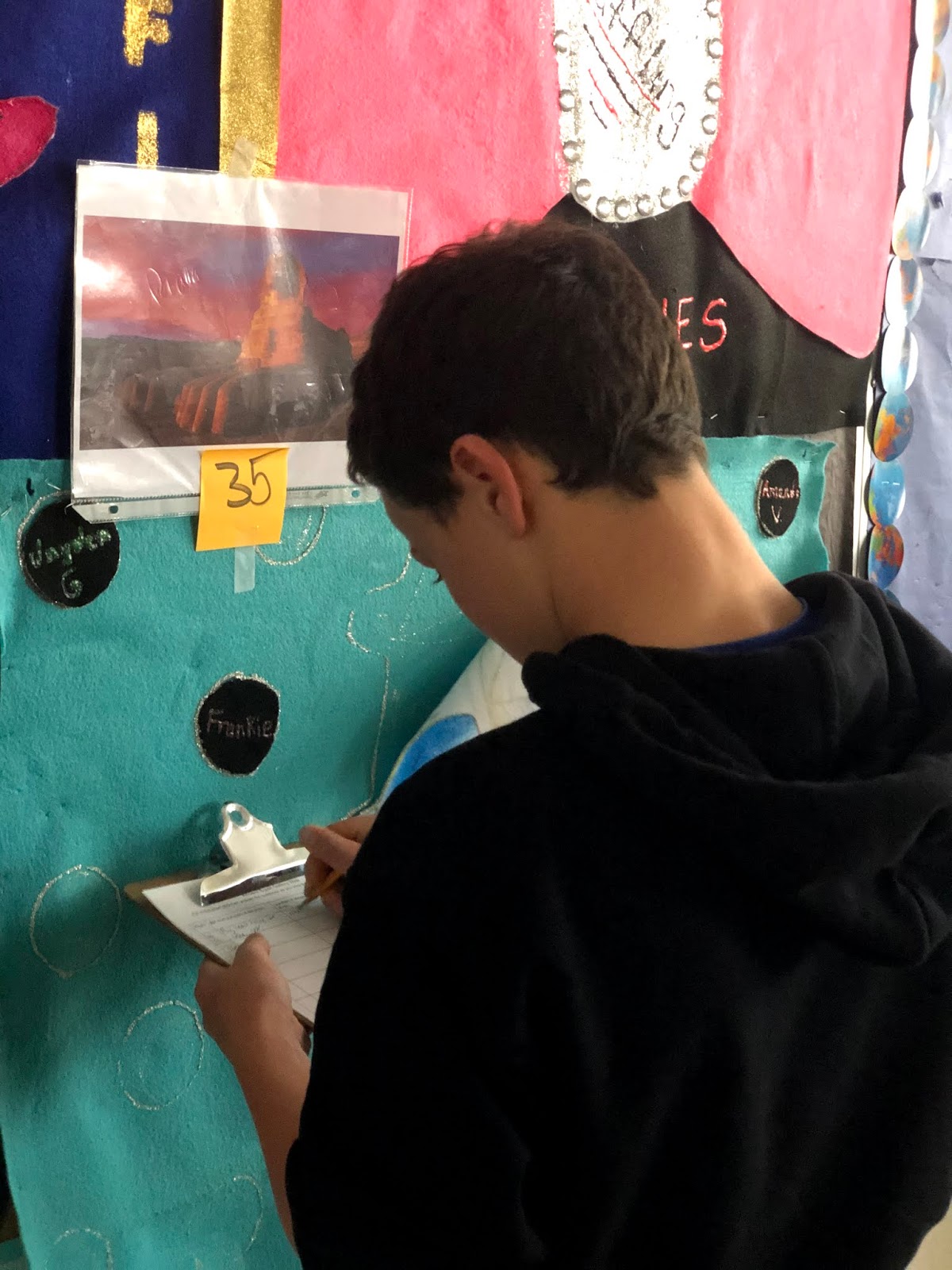
      Students engaged in a gallery walk at the start of the Ancient Egypt topic in 7th grade social studies between Katherine Botsford and Brad Ferstenou's classrooms.  Things like this where staff collaborate and design lessons together for all 60 students is what will be so nice about the design elements of the new middle school.  


      Students in 7th grade ELA working in partners as the read a short story with the purpose of determining which character in the story they feel sympathy for and why, using evidence from the text.  


      domingo, 27 de octubre de 2019

      October 27, 2019

      ______________________________________________________________________________
      Kudos
      _____________________________________________________________________________________________________
      • Thank you to all of our teachers for your hard work and dedication to our students when it comes to utilizing data to meet individual students were they are at and work to progress them forward, for example, using our iReady data to inform our iTime groups!  Thank you all for your continued commitment to all of our students!  
      • Also... thank you all for participating and being part of a great inservice this past week with Dr. Luis Cruz.  So many of you said something to either myself or Annie about how much you enjoyed Dr. Cruz or commented about being proud of the numerous things we are already doing that he mentioned "exceptional schools do"!  Thank you for all of your positive feedback, focus, and participation when he was here.  
      • Lastly, thank you to Eric Sulik and Jon Nelson for all of your continued efforts and work with our advisory curriculum.  This past Friday was a great example of The Karcher Way as our students excelled and enjoyed their time working with our Waller and Cooper students!  Thank you Eric and Jon for the behind the scenes work for the week and final afternoon!  Thank you to our staff for your focus and persistence to help your advisory students put something positive together for our elementary buddies!  
      Article this week:  

      Seventeen Thousand Classroom Visits Can't Be Wrong

      by John V. Antonetti and James R. Garver

      Chapter 1. Focus on Learning

      As the authors of this book, we have looked at instruction in more than 17,000 elementary and secondary classrooms. During this experience, we have come to recognize the power of shifting the focus from teaching to learning. This realization has come both over time and in a few blinding moments of clarity.
      A few years ago, we hosted our first annual Engagement Conference in Las Vegas. On the eve of that conference, like expectant parents, we carefully reviewed our plans for the following days, ensuring that every detail was covered. Finally, at about 10:30 p.m., John said, "I think we're ready, but you don't seem very happy."
      "What's the 'big idea' for our conference?" Jim asked.
      "That kids need to be more engaged … actively involved in learning activities."
      "And how are we starting?"
      "With your 90 minute keynote speech …"
      And at that point, we both realized that wouldn't work. So, we set about designing a new conference opening—one in which participants would be physically and cognitively involved in the work. We were nervous, because we had never seen this kind of thing done in a large general session, but it gave rise to one of our favorite sayings: "Trust the learners."
      A major purpose of this book is to help educators understand and develop this trust. Whether you are serving as a classroom teacher, site administrator, district leader, school board member, or parent, this idea can have powerful implications. In the following pages, we will share:
      • What's really going on in classrooms around the country.
      • Benchmarks to determine where your school is on the continuum of effective instruction.
      • Good classroom practices for implementation and professional development.
      • Tools and techniques to improve academic scores.
      • Qualities that will result in students being more engaged.
      • Strategies that develop higher-level thinking.
      • Techniques to lead professional learning communities (PLCs) in a new, more thoughtful direction.
      • A vision of what your school could be.
      For many reasons—the movement to standards and accountability being chief among them—one might think that a shift toward learning-focused instruction should have already happened. Unfortunately, testing elevated the importance of results but not the learning process.
      In a traditional classroom model, time is the constant and learning is the variable. That is, all students receive the same instruction for roughly the same amount of time. The results—not surprisingly—are a bell curve. Some students learn the content deeply and well, most have a moderate level of comprehension, and a few don't learn it at all. With the advent of standards, learning has become the desired constant, yet one of the most important variables—time—was never adjusted. Another element of the learning process resistant to change has been the traditional role of the teacher.
      For more than 20 years, the International Association for the Evaluation of Educational Achievement has provided educators around the world with statistics regarding math and science achievement. In 1999, the Trends in International Mathematics and Science Study (TIMSS) analyzed math classes in seven nations to examine the relationship between the cognitive demands of mathematical tasks and student achievement. In this study, a random sample of 100 8th grade math classes from each of the countries (Australia, the Czech Republic, Hong Kong [China], Japan, the Netherlands, Switzerland, and the United States) was videotaped during the school year. The six other countries were selected because each performed significantly higher than the United States on the TIMSS 1995 mathematics achievement test for 8th grade (Stigler & Hiebert, 2004).
      In the 1999 video study, the classroom math tasks were categorized as either using procedures (i.e., requiring basic computational skills and procedures) or making connections (i.e., focusing on concepts and connections among mathematical ideas). The problems were coded twice—once to characterize the type of math problem and once to describe its implementation in the classroom.
      Figure 1.1 captures the percentage of each type of math problem presented in six of the seven countries.

      Figure 1.1. Types of Math Problems Presented

      Source: From "Improving Mathematics Teaching," by J. W. Stigler and J. Hiebert, 2004, Educational Leadership, 61(15), p. 14. Copyright 2004 by ASCD. Reprinted with permission.
      Approximately 17 percent of the problem statements in the United States suggested a focus on mathematical connections or relationships. This percentage is within the range of several high-achieving countries (i.e., Hong Kong, Czech Republic, Australia).
      As students worked through the math problems, the video study analyzed teacher-student interactions and the mathematical approach taken to solve the problems. Figure 1.2 shows the coding of the student work as it was actually performed by students.

      Figure 1.2. How Teachers Implemented Making Connections Math Problems

      Source: From "Improving Mathematics Teaching," by J. W. Stigler and J. Hiebert, 2004, Educational Leadership, 61(5), p. 15. Copyright 2004 by ASCD. Reprinted with permission.
      Though the curriculum may have involved a balance in the types of problems proposed, virtually none of the making connections problems observed in the United States were implemented in a way that guaranteed conceptualization or demanded mathematical connections be made by students. There are a number of issues highlighted by the study, but the most troubling finding of all is that teachers in the United States reduced most problems to procedural exercises or simply gave students the answers—efficient teaching perhaps, but ineffectual learning.
      If the TIMSS video study had only looked at instructional delivery or the resulting achievement measures, these issues might not have been as obvious. Focusing on students during academic activities provided the greatest clarity into the achievement results.
      Why does this disconnect between curriculum and implementation occur in the United States? Math teachers across the country have shared with us many valid reasons when we ask this very question:
      • "Our curriculum is too full, inviting coverage and speed over deep mathematical understanding."
      • "The discomfort of letting our students struggle; the need to rescue our students and then move on."
      • "The pressure of the ever-present high-stakes testing."
      • "The fear that a visiting administrator who walks in during a moment of student struggle might not see the teacher 'teaching.'"
      • "It takes too long for them to figure it out."
      This challenge remains today. Math teacher Dan Meyer put it into perspective when he said that we are "taking a compelling question, a compelling answer … but we are paving a smooth, straight path between the two and congratulating our students for how well they can step over the cracks on the way" (Meyer, 2013).
      The idea of a teaching-learning shift didn't spring into our minds fully formed. As you may have already gleaned, we had the opportunity to examine teaching and learning in a variety of classroom situations—more than 17,000 and counting. We conducted the vast majority of those visits through the classroom walkthrough process. It was in that environment that we first worked together and that our ideas about the teaching-learning shift became concrete.
      In 2001, we were asked by a professional development company to help create one of the first classroom walkthough models. It became very popular, and we helped train thousands of educators across North America. In 2005, we decided to form our own organization, Colleagues on Call. To begin this new venture, we asked ourselves what we learned about classroom walkthroughs.
      The answer, unsurprisingly, came from the teachers with whom we worked. They said, "We know your visits aren't supposed to be evaluative, but sometimes it still feels like evaluation." It didn't take long to figure out why teachers felt that way: we were looking in the wrong place. Most of the data gathered and feedback provided were based on teachers' behaviors. When the focus of the visits was shifted to students, the differences were dramatic. Suddenly, we had a data set that could be gathered in no other way. Instead of monitoring whether an objective was posted on the board, students were asked to explain what they were learning and why it was relevant. In this way, thinking levels could be viewed across content areas and grade levels. Whereas formal assessments provided post-instructional data, observations made during these walkthroughs provided teachers with real-time data they could use to make instructional decisions.
      We call this process Look 2 Learning (L2L), and if you glance at the contents for this book, you will get a fairly accurate picture of what we look for—from the students' point of view—during our classroom visits.
      Here's how it works: After two days of training, L2L team members (alone or in pairs) visit classrooms in their respective schools for two to four minutes. While there, they listen to conversations and interactions, look at student work, and talk to students. Information is collected on an electronic device or on paper. Over time, the data are aggregated so trends and patterns can be observed. This information is then shared with classroom teachers, who—through reflective conversations—determine which professional practices they might like to refine. L2L data can then be used to monitor progress. Adjustments can be made and celebrations scheduled—all based, of course, on the learning and not the teaching.
      Several times in this book, we will mention the use of continua. We think they can be powerful organizers for graphically representing complex relationships and relative magnitudes. For the present discussion, a continuum can help depict the teaching-learning shift and the change in focus that happens with Look 2 Learning walkthroughs.
      In general, a continuum shows a relationship of degree that is indicated by position from left to right. It might look something like this:
      We can also make use of the vertical dimension. For instance, a point high above the line could indicate a behavior solidly in adult control, whereas one below the line could denote a significant level of student control.
      Earlier, when we discussed the shift in focus brought about by Look 2 Learning walkthroughs, we mentioned learning objectives. Where on this continuum might we locate "The objective was written on the whiteboard"? First, think vertically; we can identify this as a behavior under the control of the adult, so it should appear above the line. Now we need to determine our position horizontally. Simply posting the objective isn't very effective in improving learning by itself. Therefore, the placement of this task on the continuum might look like this:
      In an L2L context, we would contrast looking for the written objective in the classroom with determining whether students understood it well enough to explain it. Where might we place that student behavior on the continuum? Vertically, we're fully in the realm of student control, so that would indicate a placement below the line. In terms of effectiveness for learning, having students be able to articulate the objective is fairly high, locating it toward the right end of the line. Therefore, the continuum might look something like this:
      As you might imagine, this teaching-learning continuum is very useful in helping walkthrough observers understand that they should focus on behaviors that are "below the line." It also provides classroom teachers with a map for shifting the focus in their own classrooms. This shift in thinking (and the concomitant shifts in classroom practice) has the capacity to initiate powerful and fundamental schoolwide changes. Indeed, we have seen it replicated across the country. The following is but one example.
      In 2008, a team of three site-level administrators from Boise, Idaho—Dr. Betty Olson, Liz Croy, and Dr. Kelly Cross—attended our first Engagement Conference. They wanted to know more about our work with student engagement and were especially interested in Look 2 Learning. They left the conference excited, seeing potential for L2L not only in their own schools but also for the entire district. They presented what they learned to a district leadership team, which quickly championed the program. Since then, L2L was implemented in every school in the district, became part of the district's strategic plan, and served as a common vocabulary for school improvement. Each school has a Look 2 Learning coordinator who assists the principal with data collection, scheduling, and reflection.
      Dr. Olson, in particular, has used Look 2 Learning as the foundation for transforming her school. In 2010, she became principal at South Jr. High School and was determined to help the school become more learner-focused. The transformation has been transparent, incremental, and—frankly—amazing. Engagement and thinking levels have risen, lectures are rare, and discipline has improved. We recognize that Look 2 Learning didn't singlehandedly cause this change. The principal and staff still had much heavy lifting to do, but L2L provided a guide and monitoring tool for the school's evolution. It has become so much a part of the school's culture that if you sit down beside a student in class, he or she is likely to turn to you and whisper, "OK, here's what we're working on today …"
      For us, talking to students has made all of the difference. Our walks (17,124 and counting) encapsulate more than a decade of insights gained from classroom visits. They have occurred in all kinds of schools: preschool through high school, urban and rural, large and small, needy and affluent. No matter where you work, the data presented in this book invariably include schools very much like yours and are gleaned from kids very much like yours. (We have found that, overall, there is a larger discrepancy between classrooms within a school than there is between schools. In fact, we have had to begin disaggregating data for schools and districts with which we work extensively.) Our conversations are usually informative, often insightful, sometimes funny, and occasionally moving. Here are a couple of them.
      In early December, we walked into a 2nd grade classroom in South Carolina with the school's principal and assistant principal. A little boy looked up at Jim, made a terrible face, looked to the assistant principal, and then put his head down on his desk, sobbing. We all looked at one another and weren't quite sure what was going on. The assistant principal leaned down to whisper to the little guy, but the boy loudly said "I can't believe you really did it!" before putting his head back down. The assistant principal first looked puzzled but then started to laugh. She called us into the hall.
      "That young man is one of my 'frequent flyers,'" she told us. "Yesterday, he was in my office for the third time this week. Out of frustration, I told him that if he didn't begin behaving himself, I was going to call Santa Claus. Well, Dr. Garver, when he saw you, I guess he thought I did!"
      On another occasion, we were in a school somewhere west of the Mississippi. Again, it was close to the holiday season. In almost every classroom, we saw students engaged in a task with red and green construction paper. Finally, in one classroom, we saw something different: 2nd grade students coloring a calendar. The numbers stopped on the day in December that was the beginning of the school's holiday break. We tried to determine whether one of the students understood that she was working on a calendar activity.
      "What do you think those numbers stand for?"
      "They're just numbers. We have to count them."
      "Do you do anything with this after you're done coloring?"
      "We stick cotton balls on it and cover up the numbers."
      "That sounds like fun."
      "It was fun when we did it in kindergarten. In 2nd grade, not so much."
      Several of the schools with whom we work are implementing Document- Based Questioning, a process that allows students to explore complex social studies questions by examining authentic historical documents. We recently visited a 4th grade classroom where students were really buzzing. Original sources had been distributed, and groups of four were considering the question "Why did so many people die at Jamestown?"
      We stopped by one group to listen in on the conversation. The students were carefully poring over the documents when one of them spoke up.
      "I think I have a reason." He had been looking at the ship's manifest—a list of the passengers and the cargo. "There aren't any women on this list. When women aren't around, men are like pigs. They don't even wash their hands. I think the men all got dirty, sick, and died."
      Actually, that's a pretty powerful insight.
      Those are a few of our experiences listening to the learners. What would your kids say?
      ______________________________________________________________________________
      Information/Reminders
      __________________________________________________________________________________________________________________________
      • Monday, October 28 - SLOs and PPGs are due!!!!!!!!!!!!!
        • Please be cognizant and mindful of submitting your SLOs and PPGs in a timely manner.  It is important for us to analyze our student data now and then determine goals for our students and our instruction so that all students show growth and achievement from now until June!  
        • This is also a reminder that your PPG needs to be aligned to one of our Big Three.  If you have questions or need support please let Annie or myself know!  
      • Monday, October 29 - ESL - CESA 2 trainer 
        • Zane Bale, myself, and others across the school district will be meeting in the 21st Century Lab from 8:00 - 3:00 to discuss our ESL needs and services throughout the school district.  DPI contacted us and shared the concern about the number of ESL students who have been labeled as special education students.  Therefore, our time on Monday will be to work on this concern and develop solutions along the way.  
        • I will be in the building... just in the 21st Century Lab if anyone needs anything!  
      • Tuesday, October 29 - Administrative Meeting
        • Jon Nelson will be filling in as administration for all of Tuesday.  Annie and I will be at Gateway, next to the high school, with the rest of the administrative team throughout the district.  The focus of our time will be on creating and determine a needs assessment and then working to figure out what needs to be decided on first, second, and so on.  
      • Tuesday, October 29 - iTime rotation starts!  
        • A copy of your advisory and where each of your advisory students should be going starting Tuesday is already in your mailbox.  Please make sure your advisory students know where they should be going for the start of this iTime rotation.  As a reminder, all iTime groups are focused on reading or math based on our iReady student data.  
        • Click HERE to see where students should be going.  
        • All iTime groups have already been loaded into iReady to provide you with data about your students in your group!  
      • Tuesday, October 29 - Flu shots at BHS for those signed up between 2:00 - 5:00!
      • Wednesday, October 30 - PLC 
        • PLC this week will be on your own in your rooms.  Either working on Essential Skills or Strategies/Skills.  
        • Please remember the importance of the PLC reflection form after every PLC!!!  
      Looking ahead:  
      • Monday, November 4 - BLT Meeting 
      • Tuesday, November 5 - End of term 1!!! 
        ______________________________________________________________________________
        Pictures from the week
        _____________________________________________________________________________________________________

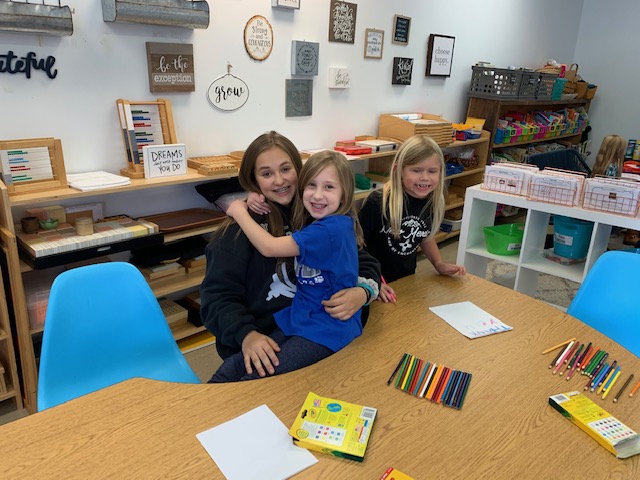
        What a great afternoon with our Waller and Cooper elementary buddies!!!  More images have also been included on our school Facebook page!