domingo, 4 de marzo de 2018

March 5, 2018

KARCHER STAFF BLOG


Karcher 2017-2018 School Calendar

Students of the week!!!!!!! 
(Running slide show) 

Facebook Page:  https://www.facebook.com/KarcherMiddleSchool/

___________________________________________


This week's article... 
_________________________________________________________________

Formative Assessment Action Plan

by Nancy Frey and Douglas Fisher

Chapter 1. Creating a Formative Assessment System

"I don't know how you're going to learn this, but it's on the test," said the professor of a graduate class on neuroanatomy that Doug was taking.
The teacher's words clearly articulated one perspective about education: Students should study and learn the content assigned to them. Her statement suggested that the teacher's job is to provide information and the students' job is to learn it, whatever way they can. When his teacher implied that the responsibility for learning rested solely on the students, Doug's confidence plummeted. Having looked at intricate pictures of the human brain, Doug was already questioning how he was going to learn this information. Now his teacher was telling him that she, too, didn't know how he (or any other student in the class) would learn it.

Understand that Doug was highly motivated to learn this content, and understand that his teacher was armed with the latest technology and instructional methods. The teacher was caring and passionate about her subject area, and, further, she had clearly communicated her high expectations at the outset of the course and summarized information weekly. Were these measures enough to ensure that Doug, and the other members of the class, reached high levels of understanding? Simply put, no. Even though high-quality instruction, innovative technology, motivation, high expectations, and passion are important in the teaching and learning process, they are not sufficient to ensure that learning occurs.
What was missing from this scenario—and from the entire class experience— was a formative assessment system. The teacher needed to establish learning goals, check for understanding, provide feedback, and then align future instruction with the students' performance. She needed an instructional framework that allowed her to feed-forward, not just provide feedback.

A Formative Assessment System

Feedback, when used as part of a formative assessment system, is a powerful way to improve student achievement. Feedback by itself, though, is less useful. As John Hattie and Helen Timperley note, "Feedback has no effect in a vacuum; to be powerful in its effect, there must be a learning context to which feedback is addressed" (2007, p. 82).
Hattie and Timperley propose a formative assessment system that has three components: feed-up, feedback, and feed-forward (see Figure 1.1). Feed-up ensures that students understand the purpose of the assignment, task, or lesson, including how they will be assessed. Feedback provides students with information about their successes and needs. Feed-forward guides student learning based on performance data. All three are required if students are to learn at high levels. Each of these three components has a guiding question for teachers and students:
  • Where am I going? (feed-up)
  • How am I doing? (feedback)
  • Where am I going next? (feed-forward)
Imagine Doug's teacher establishing the purpose for one of her classes, perhaps something like this: To use cytoarchitecture to identify locations in the cerebral cortex. She might then check for understanding, maybe through an audience response system, and provide individuals and the class with feedback. For example, she might ask, "Do the various regions of the brain contain the same number of cellular levels?" This dichotomous question has an answer (yes), and students would receive feedback about whether they had answered the question correctly. Based on the number of correct and incorrect responses, the teacher could decide what to feed-forward. The performance data from the class might suggest that the teacher needs to provide additional information and instruction to the whole class. Alternatively, the data might suggest that the teacher needs to ask specific students to elaborate on their answers so that she can determine the source of their misunderstanding. Then again, the data might suggest that the class has a good grasp on this content and is ready to move on.

Figure 1.1. A Formative Assessment System


Source: From Visible learning: A synthesis of over 800 meta-analyses relating to achievement (p. 176), by J. Hattie, 2009, New York: Routledge. Copyright 2009 by Routledge. Adapted with permission.
When all three components of a formative assessment system are present, there is a give-and-take between teachers and students that facilitates learning. The absence of any one component places learning at risk. For example, when students do not understand the purpose of a lesson (feed-up), they are unlikely to demonstrate their best effort. Without a clear purpose, students are not motivated and do not see the relevance of the content they're expected to master. When students are not assessed or do not receive assessment results (feedback), they are unsure about their performance and assume that they are doing just fine. They are unlikely to make mid-course corrections in their learning processes and understanding. When teachers fail to plan instruction based on student performance (feed-forward), misconceptions are reinforced, errors go unaddressed, and gaps in knowledge persist. Teachers march through their pacing guides and continue to "teach" while students passively observe. Unfortunately, when this is the case, teachers remain oblivious to the lack of real learning their students are doing.

Feedback Alone Is Not Enough

We have argued that formative assessment is a system with three inter-related components and that no one component alone is sufficient to ensure student learning. We want to take that one step further and focus on the ways in which feedback by itself is problematic. We have already noted that feedback should not be used in a vacuum. In part, this is because feedback is external to the learner; it is "external regulation," meaning that a student is responding because of something happening to him or her from the outside, rather than responding intrinsically or internally (Ryan & Deci, 2000). Although students may occasionally use external feedback in their internal regulations, it takes more than feedback to ensure that internal regulation occurs.
External regulation is not the only reason that isolated feedback is ineffective. Another reason is that it transfers responsibility for further learning and performance improvement back to the learner. Consider the ubiquitous research paper. Students typically work on these projects for an extended length of time, maybe even getting peer editing and feedback. Finally, the due date arrives, and the teacher takes the stack of papers home to grade. Some days later, the papers are returned with feedback. What do students do with this feedback? Anyone who's been in school knows that students either recycle the paper or, if required, make the noted changes and resubmit the paper for another round of review. The teacher has likely spent a great deal of time writing comments, but this time seems wasted when students throw away their work or simply correct the mistakes the teacher identified for them. They haven't really learned from their mistakes.
The problem bears repeating. Feedback reassigns responsibility back to the learner. Think of a recent project on which you have received feedback. After you received the feedback, did you realize that it was, once again, up to you to figure out the next steps? Were you frustrated with this experience? Did you say to yourself, "Now I have to create another one, only to be judged again? Why can't she just tell me what she wants?" If this has happened to you, you've experienced the abrupt shift of responsibility that we're talking about.
This is not to say that we don't want students to assume increasing responsibility; we do. It's just that increasing responsibility should be planned, based on student confidence and competence. We don't want students to suddenly be responsible for the first time when they make mistakes. Rather, a sophisticated formative assessment system built on a solid instructional framework should be in place from the beginning.  
This article will continue next week.  Please discuss in team time.  
______________________________________________________________________________
Kudos
_____________________________________________________________________________________________________
  • Kudos to our staff for a great first day of student led conferences!  Thank you, Ryan Heft, for covering and taking care of the library in order to free up our staff to be available for individual conferences.  Looking forward to another great turn out on Tuesday!  
  • Kudos to Jon Nelson and the high school wrestling team who competed this past weekend at team state.  It was a heart breaking loss to miss finals by one point but what a great season!  Kudos to the coaches and student athletes!  
______________________________________________________________________________
Information/Reminders...
__________________________________________________________________________________________________________________________

  • Social Studies... it is your week to provide students with a stem in order to email their parents/guardians about what has been taking place in your classes for the past 5 weeks!  
  • Monday, March 5 - BLT in the conference room from 2:40 - 3:30.  
  • Monday, March 5 - Band-O-Rama @ 7:00pm in the BHS gym.  
  • Tuesday, March 6 - Student led conferences from 4:00 - 8:00 
  • Tuesday, March 6 - Our admin team will be discussing the March 14 student walkout that is spreading among schools across the nation.  We will know more as to how Burlington will be handling this after we meet on Tuesday and will share once we know more.  
  • The book fair will be open throughout the school day this week Monday - Wednesday in the Lab.  It will also be open during conferences on Tuesday night!  
    • Students can purchase items with cash or check!  
    • If there are any books of interest to assist with your curriculum and instruction we do have funds available.  Please get any book titles and the number of copies you need to Patti Tenhagen ASAP if there is something of interest!
  • Wednesday, March 7 - Essential Skills PLC 
  • Friday, March 9 - Our Academic Bowl students will be competing at Washington-Caldwell.  Students will be leaving at 8:00 with a return time of approximately 1:15.  

Looking ahead:  
  • Monday, March 12 - Special education aide meeting from 2:40 - 3:00 in the conference room. 
  • Monday, March 12 - Secondary Curriculum Committee Meeting from 3:30 - 5:00 in the Karcher library. 
  • Tuesday, March 13 - Sing-a-bration @ 7:00pm @ BHS gym

Pictures from this past week!
Student led conferences!

domingo, 25 de febrero de 2018

February 26, 2018

KARCHER STAFF BLOG


Karcher 2017-2018 School Calendar

Students of the week!!!!!!! 
(Running slide show) 

Facebook Page:  https://www.facebook.com/KarcherMiddleSchool/

Feed Up, Back, Forward

Douglas Fisher and Nancy Frey

Teacher response is only one part of an effective feedback system. We must also set clear learning goals and let data influence instruction.

Check for Understanding

At the core of daily teaching is the ability to check for understanding in such a way that teachers learn how to help students. Fostering oral language and using questioning techniques aid this kind of informed check-in (Fisher & Frey, 2007). The evidence on using student talk as a mechanism for learning is compelling; in classrooms with higher rates and levels of student talk, more students excel academically (Stichter, Stormont, & Lewis, 2009).
Language frames help stimulate academic talk in the classroom and also help gauge students' understanding of concepts. Language frames are cloze statements that provide students with the academic language necessary to explain, justify, clarify, and ask for evidence.
In a mathematics lesson, Ms. Kelly introduced her 1st grade English language learners to the language frame "The _____ is _____-er than the ______" to help them contrast the relative size of two objects, a math standard in Ms. Kelly's district. Using a feedup strategy, she explained that the students' purpose was to approximate the size of two objects. She then had the students, in pairs, practice making sentences using this language frame in several different contexts.
On the day we observed Ms. Kelly's class, student pairs were using this frame to compare the sizes of different animals on laminated cards (see www.ascd.org/el to view a video of this lesson). When Joseph, one of the students, said, "The snake is wider than the duck," his partner Mario asked, "Is the snake wider or narrower than the duck?" to cue Joseph to rethink his answer.
Ms. Kelly let the boys know they needed to approximate more accurately and asked each boy to show the width of each animal with two hands spread apart. Joseph could gesture correctly but could not accurately convert his knowledge to spoken language. Ms. Kelly understood that the barrier was language and not the measurement concept, so she concentrated on reteaching the language frame until Joseph could use it correctly (the feed-forward element).
Questioning is vital to checking for understanding, especially as it pertains to giving feedback on incorrect responses. When faced with a student error, we should remind ourselves that the answer usually makes sense to the student and reflects what he or she knows and does not know at the moment. We can rapidly form a hypothesis about what the student might not know to provide a prompt that will help that student achieve the needed understanding. Walsh and Sattes (2005) suggest these follow-up prompts:
  • Words or phrases that foster recall ("Think about the role of hydrogen").
  • Overt reminders to trigger memory ("The word begins with d").
  • Probes that elicit the reasoning behind the answer to identify knowledge gaps ("What led you to think the character would do that?")
  • A reworded question that reduces language demands. For example, instead of asking a student to "identify the role of tectonic plates in earth geophysical systems," the teacher might say, "Earthquakes and volcanoes have something in common; let's talk about that."

Use Common Assessments

In addition to providing a way to check daily for understanding, an aligned system includes common formative assessments that enable teachers to coordinate with other teachers in their grade level or department. These assessments are usually based on units of instruction and become part of the pacing guide for each course. Such benchmark assessments gauge increments of student performance and provide teachers with data that spur conversation about instructional and curricular design.
We recommend that teachers meet in advance of teaching a unit to develop common formative assessments. The assessment items teachers select should be geared to diagnose specific kinds of learning so that teachers can discuss any misconceptions students still hold after instruction and recognize patterns among students (Fisher, Grant, Frey, & Johnson, 2007). Teachers should meet as soon as possible after they score each assessment to discuss the relationship between the results and teachers' instruction and to plan next steps (the feed-forward component).
Partial conceptual understanding is a common cause of incorrect responses. For example, Ms. Goldstein's English as a second language class was studying affixes in preparation for a benchmark assessment. Ms. Goldstein explained that the lesson's purpose was to analyze new vocabulary words (feed up). Omar incorrectly identified in- as the prefix for interlude. Rather than simply supply Omar with the correct answer and move on, Ms. Goldstein asked him what the prefixes in- and inter- meant and received a correct reply. "Could the root be '-lude,' or is it '-terlude'?" Ms. Goldstein questioned. Omar stayed with his initial incorrect answer, so she tried again, asking Omar's small group, "Is the prefix in- or inter-? I'll let you figure it out" (providing feedback that something needed to be figured out).
Omar's group talked about the two meanings and how they would affect the overall word. Ms. Goldstein checked a few minutes later on whether Omar and his group had arrived at the correct answer.
After the English as a second language department administered its common formative assessment on affixes, Ms. Goldstein remarked, "I noticed some students in my class getting similar prefixes like in- and inter- confused. This was a pattern in all our classes. How can we teach look-alike prefixes more effectively?" The teachers decided to develop a Jeopardy-style game that included easily confounded affixes to give students practice.

Identify Competencies

Although unit-based formative assessments are valuable benchmarks to inform teachers' instruction, they offer students only snapshots of their progress. Learners need a system to measure their own attainment of course goals. Goals should be a balance of short-term ("I'm going to ask good questions today") and long-term ("I'll pass biology"); however, the gap between short-term and long-term goals can be overwhelming. Creating a system of specific competencies that students should achieve in a course and a series of assessments that measure those competencies and provide clear feedback enable students to measure their progress through any course.
Grade-level teams or departments usually specify course competencies and corresponding assignments. Competencies should reflect the state standards while offering students an array of ways to demonstrate mastery, not just paper-and-pencil tasks. The competency assessments should be numerous enough that students can adequately gauge their own progress at attaining competencies; generally 7 to 10 per academic year is best.
Ninth and 10th grade English teachers at one high school devised a series of 10 competency assessments for their common courses. These included four essays based on schoolwide essential questions, two literary response essays, an oral language assessment that included retelling a story and delivering a dramatic monologue, a poetry portfolio, and tests on persuasive writing techniques and summarizing.
These teachers designed a two-week unit on plagiarizing that, as they explained to students in a "feed-up" message, would help them write their formal essays. The teachers developed a common formative assessment that measured how well students could cite information from a newspaper article, a Web site, a book with two or more authors, and an interview. The results indicated that even after studying plagiarism, many students still couldn't correctly cite online sources. Knowing that students would need this competency to write their first essay, teachers analyzed students' incorrect answers and retaught the specifics of this type of online citation accordingly.

Build Toward State Assessments

An aligned system of assessments should build toward helping students do well on state tests that measure the progress of students and schools. Although we do not believe a few weeks crammed with test-prep worksheets are useful, we do believe that students should understand that tests are a genre, one they are capable of mastering. And we advocate assessment practices that build test wiseness by giving students encounters with test formats in the context of meaningful instruction.

For example, a math teacher might model thinking aloud as she eliminates distractors on multiple-choice questions. When faced with the problem 1/7 + 3/7 and three answer choices of 4/7, 3/7, and 4/14, the teacher might say, "I see one of the choices has 14 as a denominator. But I know you don't add the denominator when adding fractions so that can't be correct." When teachers embed test-format practice within daily checking for understanding, formative assessments, and course competency exams, students acquire the stamina and skills they need to score well on state assessments.
______________________________________________________________________________
Kudos
_____________________________________________________________________________________________________ 
  • Kudos again to Steve Berezowitz and Marian Hancock for all of your work with getting all student course selection sheets completed for the 2018-2019 school year.  It is a lot of behind the scenes work in order to get the ball rolling for next year!  
  • Kudos to our staff on getting your SLOs submitted.  Do not worry if you are still inputing data into your SLO for your mid-year.  It is ok! 
______________________________________________________________________________
Information/Reminders...
__________________________________________________________________________________________________________________________
  • Reminder:  It is important to communicate with parents/guardians when it comes to their student's academics.  I have had an increase in parent concerns with a lack of communication from staff about what is going on in classes, when exams will be, etc.  Please make sure you are sending information to all of your student's parents weekly or biweekly (at the minimum).  
  • Science - it is your week to have students email their parents/guardians.  
    • Reminder to all... Providing them with a writing stem prompt helps with the writing process and making suggestions for them to write is encouraged as well.  Please take the time during the week to give students the opportunity to craft and write a email to their parents/guardians.  
  • Monday, February 26 - Secondary Curriculum Committee @ 3:30 - 5:00 in the Karcher library.  
  • Tuesday, February 27 - Start of iTime rotation #5!
  • Wednesday, February 28 - Essential Skills PLC
  • Thursday, March 1 - First day for Student Led Conferences.  
    • Student Plans/Template 
    • This LINK is the form for the parents to sign up for conferences.  
    • Your expectation as the advisory teacher is to check the responses to see if your advisory students are signing up for their conferences.  Please email families individually or call home to assist with setting up their student led conference if you are not seeing their names in the list.  
      • Again, please just assist with the students in your advisory in order to assist with our turn out!  
    • The student led conferences will be held in the library.  Everyone will need to bring their chromebook cart up to the library prior to 4:00 on both days for students to access their chromebooks.  
    • Staff will then be in your rooms for conferences throughout the 4:00 - 8:00 time frame.  (Same format as last year) 
    • Please bring your chromebook cart up to the library on Thursday prior to 4:00 with your name written on a paper on the top so that students are able to locate your chromebook cart.  We will have 8th grade advisory carts lined under the windows in the library and 7th grade along the book shelf on the left side of the library.  
Teachers: 

  • 2018-2019 Budget Information:
    • We are under what our school budget was for the 2017-2018 school year.  So, please stay very close to what you were in terms of your budget for this coming school year.  
    • All forms are in Google Docs again so... please complete all of our budget information in Google Docs in the below forms and then send them to Kim via Google Docs.  Please do not just share, make sure she knows you sent them to her.  
    • When naming your below documents please use this naming convention so that it is easy to search:  Last Name - Budget Requisition Order Form,   Last Name - 2017-2018 Budget Worksheet Form   (Example:  Ebbers - Budget Requisition Order Form)
      • THIS form is what everyone needs to fill out for your entire budget.  This form indicates the total amount you need/will have for the 2018-2019 school year. 
        • The above form is all Kim needs you to fill out if there are no items you need on your list prior to the start of the school year.  Meaning, if you are wanting to just purchase items as you need them the above form is all you need to fill out.  
        • Use THIS form to request items that are needed for the start of the school year. 
      • If you do not know your Function Number (Example:  English 122200) email or ask Kim and she will help with what your number is.  
      • Please send your budget information to Kim no later than March 9!  
    • Reminder to utilize the Warehouse for items we already keep a supply of within the district versus using your budget for those items - images below are warehouse items.    If you would like a copy of this Kim/Jane have it in the main office. 


Pictures from this past week!
Rube Goldberg club in action!  We currently have four teams... all hoping to compete in April at the Middle School Rube Goldberg competition!


lunes, 19 de febrero de 2018

February 20, 2018

KARCHER STAFF BLOG


Karcher 2017-2018 School Calendar

Students of the week!!!!!!! 
(Running slide show) 

Facebook Page:  https://www.facebook.com/KarcherMiddleSchool/


Feed Up, Back, Forward

Douglas Fisher and Nancy Frey
Teacher response is only one part of an effective feedback system. We must also set clear learning goals and let data influence instruction.
Like the sailors in Samuel Coleridge's poem "The Rime of the Ancient Mariner" who see "water, water everywhere, nor any drop to drink," teachers often feel awash in a resource that is of little help. Teachers have more assessment data about individual students at their fingertips than we could have imagined a decade ago. Unlike saltwater to a thirsty mariner, the data are of course highly usable resources for teachers. Yet many feel unable to "drink" the data around them because they don't have a system for processing it.
We recently saw a teacher collect literacy assessment data on her iPhone and then upload the scores instantly into the school's computer. It was impressive. When we asked how she planned to use this information, however, the teacher replied, "It's just a benchmark test I'm required to give; I don't really use the data." Therein lies the problem: A resource that could significantly enhance teaching and learning is left unused.

The solution is twofold. First, educators have to understand the three components of any powerful feedback system. Second, we have to align the multiple measures we use to create a coherent system of data collection, analysis, and instruction that responds to data in a way that lifts student achievement.

What Makes a Strong Feedback System?

Feedback is a powerful way to affect student achievement (Hattie & Timperley, 2007). Research consistently ranks feedback as among the strongest interventions at teachers' disposal (Kluger & DeNisi, 1996). But feedback is a complex construct with at least three distinct components, which we call feed up, feed back, and feed forward. To fully implement a feedback system, teachers must use all three.

Feed Up: Clarify the Goal

The first component of an effective feedback system involves establishing a clear purpose. When students understand the ultimate goal, they are more likely to focus on the learning tasks at hand. Establishing a purpose is also crucial to a feedback system because when teachers have a clear overall purpose, they can align their various assessments. For example, when it's clear that the purpose of a unit is to compare insects and arthropods, students know what to expect and the teacher can plan readings, collaborative projects, investigations, and assessments to ensure that students focus on content related to this goal.

Feed Back: Respond to Student Work

The individual responses teachers give students about their work are the second component of a good feedback system, and the one that is most commonly recognized. These responses should directly relate to the learning goal. The best feedback provides students with information about their progress—or lack of it—toward that goal and suggests actions they can take to come closer to the expected standard (Brookhart, 2008). Ideally, teachers give feedback as students complete discrete tasks that are part of a larger project so that students can use teachers' suggestions to better master content and improve their performance on the larger project.
For example, in a unit on writing high-quality introductions, a teacher gave students multiple opportunities to introduce topics using such techniques as beginning with a question or startling statistic, leading off with an anecdote, and so on. The teacher provided students feedback on each introduction they wrote so students could revise that introduction and use the suggestions to improve their next attempt. Rather than simply noting mechanical errors, the teacher acknowledged areas of success and highlighted things students might focus on sharpening.

Feed Forward: Modify Instruction

This formative aspect of a feedback system is often left out. In an effective feedback system, teachers use assessment data to plan future instruction; hence the term feed forward. As teachers look at student work, whether from a checking-for-understanding task or a common formative assessment, they use what they learn to modify their teaching. This demands greater flexibility in lesson planning because it means that teachers can't simply implement a set series of lessons.
For example, student groups in one 3rd grade class we observed each completed a collaborative poster in response to a word problem. Students had to answer the questions in each problem using words, numbers, and pictures. A typical problem read, "Six students are sitting at each table in the lunchroom. There are 23 tables. How many students are in the lunchroom?" Nearly every group got the wrong answer to its problem. Given this information, the teacher knew she needed to provide more modeling to the entire class on how to solve word problems.
Another teacher noted that six of his students regularly capitalized random words in sentences. Mauricio, for example, incorrectly capitalized fun, very, and challenge. Considering that the other students were not making this error, the teacher knew that a whole-class intervention was unnecessary. Instead, he provided additional instruction for the six students who consistently capitalized at random.

Moving Toward Alignment

For a feedback system to be informative, all measures must align with one another to present a rich portrait of how students are progressing toward a common goal. For example, daily checking-for-understanding practices should contribute to a teacher's understanding of how students will perform with similar material in a unit, in a course, and on state assessments. 
______________________________________________________________________________
Kudos
_____________________________________________________________________________________________________
  • Kudos to Marian Hancock, Becky Hoesly, Steve Berezowitz, Barb Berezowitz, Andrea Hancock, and Ryan Heft for your assistance and help with scheduling last week at Dyer, Karcher, and for the HS.  
  • Kudos to Jack Schmidt, Eric Sulik, Wendy Zeman, Ryan Heft, and the rest of our staff for a great character education Integrity day this past Friday morning with the HS DRIVEN students!  It was a great morning and great topic for our students to engage in.  
______________________________________________________________________________
Information/Reminders...
__________________________________________________________________________________________________________________________
  • Math... it is your week to have students email their parents/guardians.  
  • Thursday, March 1 and Tuesday, March 6 - Student Led Conferences from 4:00 - 8:00pm.  
    • This LINK will be send to parents via Skyward on Tuesday, February 20.  There are 35 "seats" available for each time slot within the form.  
    • Would the following four people also send this link to parents via email as well to ensure all families are seeing the link:  
      • Kurt Rummler
      • Stephanie Rummler
      • Barb Berezowitz 
      • Andrea Hancock  
    • Your expectation as the advisory teacher is to check the responses to see if your advisory students are signing up for their conferences.  Please email families individually or call home to assist with setting up their student led conference.  Again, you are just responsible for students in your advisory in order to assist with our turn out!  
    • The student led conferences will be held in the library.  Everyone will need to bring their chromebook cart up to the library prior to 4:00 on both days for students to access their chromebooks.  
    • Staff will then be in your rooms for conferences throughout the 4:00 - 8:00 time frame.  (Same format as last year) 
    • Student Plans/Template 
  • Tuesday, February 20 - Mid-Year SLOs are due in MLP.  
  • Wednesday, February 21 - Essential Skill PLC work in your rooms with your content area.  Ryan and I will be available in the library for any teams wanting support.
Looking ahead:  
  • Monday, February 26 - Secondary Committee Meeting - Rescheduled date from 3:30 - 5:00 in our Karcher library.  
  • Tuesday, February 27 - Start of the next iTime rotation!  
  • Thursday, March 1 - Student Led Conferences from 4:00 - 8:00.  
Pictures from this past week!
Students on Friday collaborating and participating with the HS DRIVEN students with activities focused around Integrity!  


 Some students in 8th grade are participating in literature circles during iTime!

 Student Council/Leadership selling Valentines!  

STEM projects where the goal is to utilize at least two simple machines to make a compound machine.


Student choice in Art class with their new ceramic project.  Students can use any of the following techniques for their ceramic sculptures:  coil, pinch, slab, or free style.  

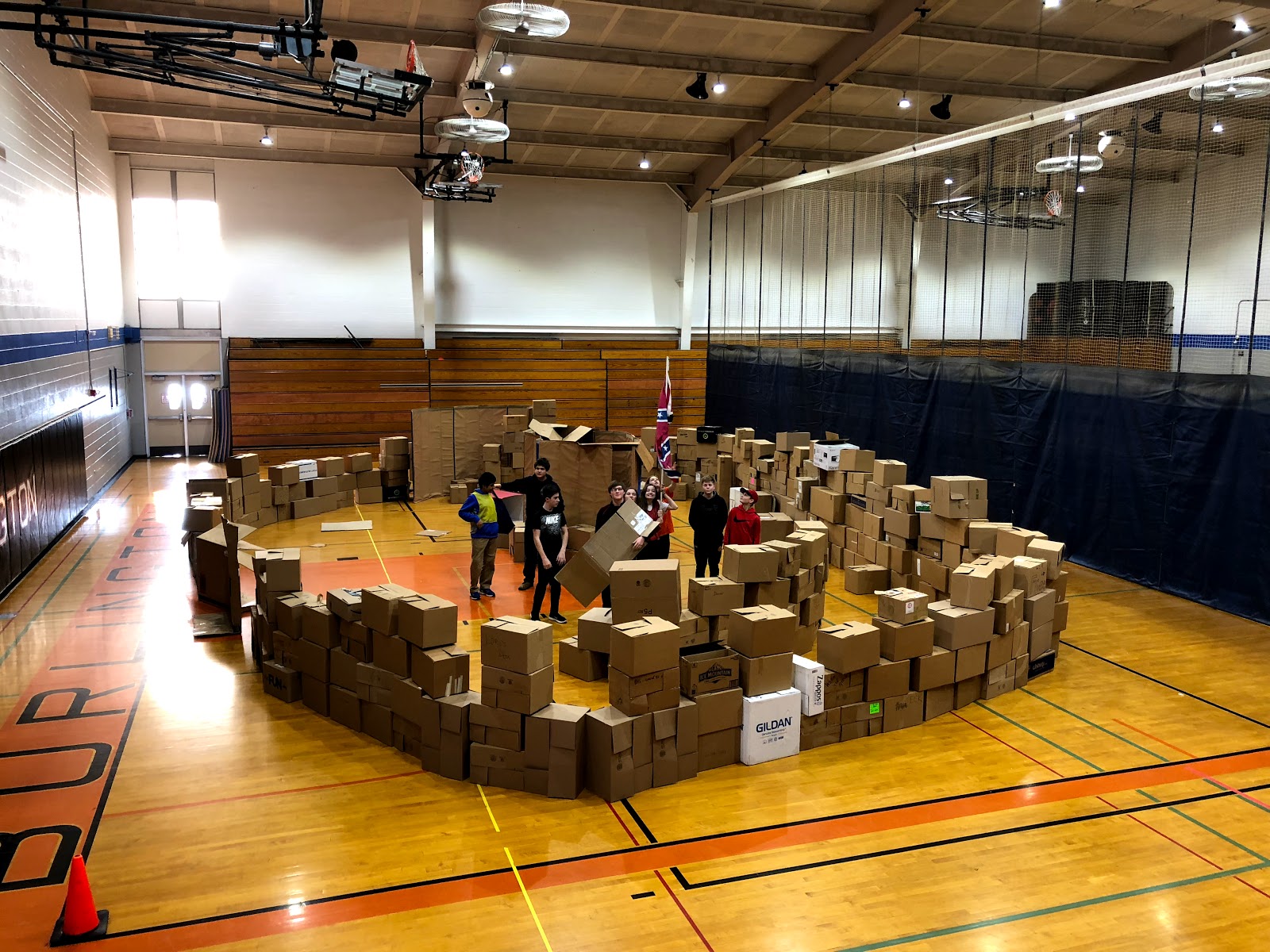
8th grade epic Civil War battle!