sábado, 3 de febrero de 2018

February 5, 2018

KARCHER STAFF BLOG


Karcher 2017-2018 School Calendar

Students of the week!!!!!!! 
(Running slide show) 

Facebook Page:  https://www.facebook.com/KarcherMiddleSchool/

___________________________________________


This week's article... 
_________________________________________________________________

Know Thy Impact, John Hattie


Teachers give a lot of feedback, and not all of it is good. Here's how to ensure you're giving students powerful feedback they can use.

Continuation of last week's article...

The Three Levels of Feedback

It's important to realize that feedback will look somewhat different at three separate levels:

Task Feedback

Feedback at this level describes how well the student performs a given task—such as distinguishing correct from incorrect answers, acquiring specific information, or building surface knowledge. The feedback clarifies what the student needs to do to improve his or her performance of that task.
For example, let's suppose a teacher is teaching students how to narrate events in a story in chronological order. The feedback to one student might be as follows:
Your learning goal was to structure your account in a way that the first action you described was the first thing you did. Then you were to write about the other things you did in the same order in which they happened.
You did write the first thing first—but after that it becomes muddled. You need to go through what you've written and number the order in which events happened and then rewrite them in that order.

Process Feedback

Feedback at this level describes the processes underlying or related to tasks, such as strategies students might use to detect or learn from errors, cues for seeking information, or ways to establish relationships among ideas.
For example, a teacher might suggest the following to a reader who stumbles on an unfamiliar word:
You're stuck on this word, and you've looked at me instead of trying to work it out. Can you see why you may have gotten it wrong? Perhaps you could sound out the word, look it up on your tablet, or infer its meaning from the other words in the paragraph.
Alternatively, a teacher might guide a student who is having difficulty relating ideas in a text by saying, "I've asked you to compare these ideas—for example, you could start out by listing ways they're similar or different. This would give you information about how they relate to one another."

Self-Regulation Feedback

This level of feedback describes how learners can monitor, direct, and regulate their own actions as they work toward the learning goal. Feedback at this level fosters the willingness and capability to seek and effectively deal with feedback, to self-assess and self-correct, to attribute success to effort more than to ability, and to develop effective help-seeking skills.
For example, when giving feedback to a proficient reader who is stumped by a vocabulary word, the teacher might say,
I'm impressed you went back to the beginning of the sentence when you became stuck on this word. But in this case, this strategy didn't help. What else could you do? When you decide on what the word means, tell me how and why you know.
A teacher might promote a student's help-seeking and error-detection skills by saying the following:
You checked your answer with the resource book and found you got it wrong. Any idea why you got it wrong? What strategy did you use? Can you think of a different strategy to try? How will you know if your answer is correct?
The power of feedback involves invoking the right level of feedback relative to whether the learner is a novice, somewhat proficient, or competent. Novices mostly need task feedback; those who are somewhat proficient mostly need process feedback; and competent students mostly need regulation or conceptual feedback.

In addition to maximizing feedback at the appropriate level, teachers also need to be attentive to moving the student forward from mastery of content to mastery of strategies to mastery of conceptual understandings. For this to occur, teachers need to give students feedback that is at and just above their current level of learning.
This article will continue next week as well... please discuss during team time!
______________________________________________________________________________
Kudos
_____________________________________________________________________________________________________
  • Kudos to Brad Ferstenou, Stephanie Rummler, and our leadership/student council students on a GREAT idea to have snow cones after lunch this past week as a KCB reward!  Students loved it!  
  • Thank you to everyone that assisted with FNL:  Mike Jones, Donna Sturdevant, Stephanie Rummler, Amanda Thate, Hans Block, Mary Blankenship, Bobbi Smith, Ryan Heft, and Mia Schultz! We had a great turn out with 12 dodgeball teams signed up (usually we have 7-8 teams), ping pong, video games, board games, cards, and the movie Wonder.  Great job planning it all Mike Jones and Donna Sturdevant!   
  • Thank you to Marian Hancock for all of your efforts and work assisting these past few weeks with MAP testing make ups!  We need to finish up this Monday as the window needs to close ASAP!  Information about MAPs is below.  
  • Kudos to Steve Berezowitz and your work with our 8th grade students on preparing them for their high school course selections!  
  • Thank you to Kris Thomsen for getting things started for a Super Bowl luncheon on Friday.  Crazy amount of great food!  Thank you to all that participated!  Dustan's macaroni and cheese was a hit!  
  • Thank you to Amanda Wilks for your dedication to our students.  These past few weeks have brought on some sicknesses and the clean up is not always the most enjoyable but Amanda does an amazing job treating all students with kindness, empathy, and respect!  
______________________________________________________________________________
Information/Reminders...
__________________________________________________________________________________________________________________________
  • Applied Academic teachers... it is your week to have students email parents/guardians!  
  • Monday, February 5 - 7th grade students to the auditorium during advisory.  
    • After announcements and attendance please bring your advisory students to the auditorium for a quick conversation about 8th grade scheduling.  We will be handing out course booklets along with an applied academic course request form to all students.  The forms will be due back on Friday, February 9.  Students can turn them into their advisory teachers or the library.  If they give them to you in advisory please drop them off in the box that will be on the counter in the library by Marian.  All forms should be signed by a parent/guardian in order to turn them in.  
  • Monday, February 5 - All students who need to complete a MAP test need to go to the library right after announcements (8th grade) and right after the auditorium (7th grade).  This is very important as we need to finish up our MAP testing ASAP. The students who need to finish testing were sent to everyone in an email from Marian Hancock.  Students on the list will remain in the library for testing until they are 100% complete.  Thank you for your understanding as this provides us with great data to utilize in order to analyze our students academic growth and were needs are.  
  • Monday, February 5 - Secondary Curriculum Committee Meeting @ 3:30 - 5:00 in our Karcher library.  
  • Tuesday, February 6 - 8 - Steve Berezowitz will continue working with our 8th grade students during their compass time on high school scheduling.  
  • Wednesday - February 7 - PLC will be focused on Essential Skills within your teams.  Initially we were going to look at MAP data for this PLC but I will be at the principal conference and we are still wrapping up MAP so we will analyze our MAP data as a team in the library next week, February 14, for PLC.  
  • Monday, February 12 - Freshmen Open House!  
    • The following handout has been given to them during their time with Steve Berezowitz this past week.  We have also shared with parents via the blog and emails.  Please remind students about this event for them to walk the school, hear about course offerings, and sign up for clubs!  

  • Monday, February 12 - BLT Meeting 2:40 - 3:30 in the conference room.  
Additional information:
  • Staff websites need to be updated prior to us rolling over to our new website!  Please click on THIS link in order to login and make changes and adjustments to your website information.  Everyone is encouraged to look at it as some information is a few years old now.  If you do not use certain components (have a website but don't use it anymore) please delete those items as well.  
  • All club advisors... please email Kim the start and end dates for your club.  Even if it took place already or started in September we are wanting all information in the website to be accurate.  Give her the following information about your club:  Start/end date, days during the week you meet, start and end time, all club advisory advisors, name of your club.   Even if you think we have your club information already please get these items to Kim so we can double check that everything is accurate.  Please have get her this information by February 9, Friday.  Thank you! 
  • Just a reminder... your mid-year SLO is due on February 20 within MLP.  If you used first semester (applied academic teachers) for your SLO then you should have all three submitted by February 20.  If you are using second semester please make sure your beginning of the year SLO is completed.    
  • Just an FYI... Karcher will be used as a training site for our Burlington Police Department and the drug dogs on Saturday, February 10.  They frequently train in buildings around the city in order to provide different situations and scenarios for the dogs and officers.  
Pictures from this past week!

7th grade science - perch dissection


8th grade science - sheep eye dissection


Girls Volleyball!  

String Festival this past Tuesday!


Snow cones!  


Our new weight lifting club!

Friday Night Live!  


domingo, 28 de enero de 2018

January 29, 2018

KARCHER STAFF BLOG
______________________________________________________________________________
Kudos
_____________________________________________________________________________________________________
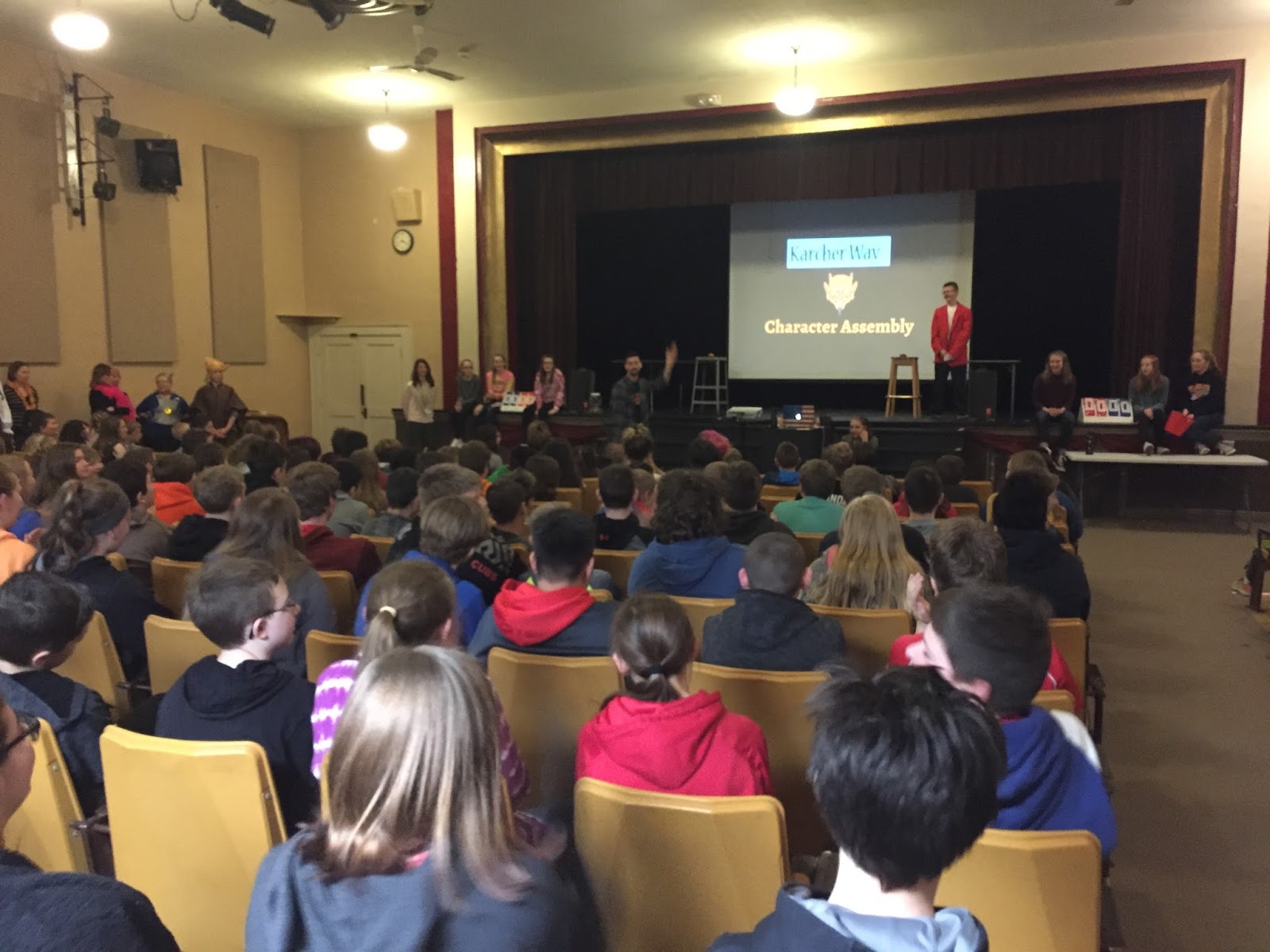
  • Kudos to our staff on two well done Character Assemblies!  Thank you to Brad Ferstenou and Stephanie Rummler on your leadership with our student council/leadership students and the running of Family Feud!  And kudos to staff for being so thoughtful and kind in your words when presenting your Character Awards to our students.  Great job everyone!!!  

___________________________________________

This week's article... 
_________________________________________________________________

Know Thy Impact, John Hattie

Teachers give a lot of feedback, and not all of it is good. Here's how to ensure you're giving students powerful feedback they can use.
Many years ago, I made a claim about the importance of giving students "dollops of feedback" (1999). This endorsement of giving great amounts of feedback was based on the finding that feedback is among the most powerful influences on how people learn.
The evidence comes from many sources. My synthesis of more than 900 meta-analyses (2009, 2012) shows that feedback has one of the highest effects on student learning. These meta-analyses focused on many different influences on learning—home, school, teacher, and curriculum—and were based on more than 50,000 individual studies, comprising more than 200 million students, from 4- to 20-year-olds, across all subjects. As an education researcher, I was seeking the underlying story about what separated those influences that had a greater effect on student learning from those that had a below-average effect. Feedback was a common denominator in many of the top influences. Moreover, Dylan Wiliam (2011) has argued that feedback can double the rate of learning, and an increasing number of scholars are researching this important notion (see Sutton, Hornsey, & Douglas, 2012).
I've come to regret my "dollops" claim because it ignores an important associated finding: The effects of feedback, although positive overall, are remarkably variable. There is as much ineffective as effective feedback. My work over the past years has concentrated on better understanding this variability and on clarifying what makes feedback effective—or not.

Some Questions to Start With

When we ask teachers and students what feedback looks and sounds like, we need to consider three important questions. The first question is, Where is the student going? Feedback that answers this question describes what success would look like in the area in which the student is working and what it would look like when he or she masters the current objective. Such feedback also tells us what the student would need to improve to get from here to there. For example, in a science class, the answer to, Where am I going? might be to "understand that light and sound are types of energy that are detected by ears and eyes"; students know they're there when they can discuss how light and sound enable people to communicate.
The second question is, How is the student going? Feedback that answers this question tells where the student is on the voyage of learning. What are the student's gaps, strengths, and current achievement? During the unit on light and sound, the teacher might give pop quizzes and encourage student questions and class discussion to show both students and teacher how they're going.
The third question—Where to next?—is particularly important. When we ask teachers to describe feedback, they typically reply that it's about constructive comments, criticisms, corrections, content, and elaboration. Students, however, value feedback that helps them know where they're supposed to go. The science teacher might point out, "Now that you understand types of energy, you can start to see how each affects our listening skills." If this Where to next part is missing, students are likely to ignore, misinterpret, or fail to act on the feedback they hear. They need to know where to put their effort and attention.
Of course, we want students to actively seek this feedback, but often a teacher's role is to provide resources, help, and direction when students don't know what to do. Simply put, students welcome feedback that is just in time, just for them, just for where they are in their learning process, and just what they need to move forward.

How to Make Feedback More Effective

For feedback to be effective, teachers need to clarify the goal of the lesson or activity, ensure that students understand the feedback, and seek feedback from students about the effectiveness of their instruction.

Clarify the Goal

The aim of feedback is to reduce the gap between where students are and where they should be. The teacher, therefore, needs to know what students bring to each lesson at the start and to articulate what success looks like. The teacher might demonstrate success with a worked example, scoring rubrics, demonstrations of steps toward a successful product, or progress charts. With a clear goal in mind, students are more likely to actively seek and listen to feedback.
A good comparison is to video games. The game keeps tabs on the player's prior learning (past performance); sets a challenge sufficiently above this prior learning to encourage the user to work out how to achieve the challenge; and provides many forms of feedback (positive and negative) to help the learner get to the target. The learner typically finds this process attractive enough to continue moving through increasingly challenging levels of the game.
In the same manner, effective teaching requires having a clear understanding of what each student brings to the lesson (his or her prior understanding, strategies for engaging in the lesson, and expectations of success); setting appropriate challenges that exceed this prior knowledge; and providing much feedback to assist the learner in moving from the prior to the desired set of understandings.

Ensure That Students Understand the Feedback

Teachers and leaders often give a lot of feedback, but much of this feedback isn't received. For example, when a teacher gives feedback to the whole class, many students think it's not meant for them but for someone else. Or sometimes we ask students to react a day later to feedback that a teacher has provided on an assignment. Students typically miss the teacher messages, don't understand them, or can't recall the salient points.
When we monitor how much academic feedback students actually receive in a typical class, it's a small amount indeed. Students hear the social, management, and behavior feedback, but they hear little feedback about tasks and strategies. Teachers would be far more effective if they could confirm whether students received and understood the feedback. This may mean listening to students outline how they interpret teachers' written comments on their work and what they intend to do next.

Seek Feedback from Students

When teachers enter their classrooms intending to seek and receive feedback from students about the effect of their teaching—both about their instruction, messages, and demands and about whether students need specific assistance, different strategies, or more or repetitions of particular information—the students are the major beneficiaries. These forms of feedback enable the teacher to adapt the flow of the lesson; to give needed directions or information to maximize students' chances of success; and to know whether it's necessary to reteach or offer different tasks, content, or strategies.

______________________________________________________________________________
Information/Reminders...
__________________________________________________________________________________________________________________________

  • Social Studies teachers... it is your week to have students email their parents/guardians!  
  • Monday, January 29 - Extended Advisory (normal for 7th grade)
    • 8th grade advisories will be meeting with Eric Burling in the auditorium as he will share information about their Freshmen year and course selections.  
      • Please bring your advisory to the auditorium right after you read the announcements and take attendance.  
      • Note:  8th grade only... once Eric Burling is done please bring your advisory students back to your advisory (no STAR/Spanish time) to allow time for questions with you and time to glance over the course selection booklets.  
      • ****** Please come to the main office to take a stack of booklets for your advisory students prior to the start of the school day!  
  • Monday, January 29 - Start of Reading MAP in Social Studies classrooms.  
    • Please be cognizant of noise in the hallways, etc. in order to provide a quiet testing environment throughout the week.  
  • Monday, January 29 - 2018-2019 course requests sheets will be given to Molly Ebbers and Wendy Zeman to start working on which students will be in intervention.  
  • Tuesday, January 30 - Start of iTime rotation #4!  
  • Tuesday, January 30 - Strings Festival @ BHS @ 6:30pm!  
  • Wednesday, January 31 - Essential Skills PLC.  
  • Wednesday, January 31 - Start of 8th grade students working with Steve on HS scheduling during their compass period.  
  • Friday, February 2 - Friday Night Live (FNL) from 6:00 - 7:30pm @ Karcher!  
    • Those willing to volunteer your time please let Mike Jones or Donna Sturdevant know!  Thank you!!!

Pictures from this past week!
7th grade!

8th grade!


domingo, 21 de enero de 2018

January 22, 2018

KARCHER STAFF BLOG


Karcher 2017-2018 School Calendar

Students of the week!!!!!!! 
(Running slide show) 

Facebook Page:  https://www.facebook.com/KarcherMiddleSchool/

___________________________________________

This week's article... 
_________________________________________________________________

Book:  How to Create and Use Rubrics for Formative Assessment and Grading by Susan M. Brookhart


Chapter 10. Rubrics and Formative Assessment: Feedback and Student Self-Assessment

Formative assessment is an active and intentional learning process that partners the teacher and students to continuously and systematically gather evidence of learning with the express goal of improving student achievement (Moss & Brookhart, 2009, p. 6). Formative assessment is about forminglearning—that is, it is assessment that gives information that moves students forward. If no further learning occurred, then whatever the intention, an assessment was not formative.


Chapter 9 described how to use rubrics to help clarify learning targets for students—the foundational strategy of formative assessment. This chapter covers the use of rubrics for giving feedback that feeds forward, for supporting student self-assessment and goal setting, and for helping students ask effective questions about their work.

How to use rubrics for teacher and peer feedback

Because rubrics enumerate the criteria for learning and describe performance along a continuum for each one, they are a good framework for feedback. This section presents several strategies for using rubrics as the basis for teacher and peer feedback. Use one of them or design similar strategies that work in your context.

Teacher feedback on rubrics-based feedback sheets

If you are using well-written, general, analytic rubrics (as I recommend for most purposes) for sharing with students and for feedback, you can photocopy the rubrics themselves, leaving space for comments. Provide feedback by circling the performance level for each criterion that best matches the student's work in its current form. Then you will not have to rewrite the general description, which is already circled. Instead, use what time you have available for written feedback to write something specific to the student's work.
For example, if the class is working on the ideas in their writing, the teacher may give feedback on writing using the Ideas rubric in the 6+1 Trait Writing rubrics (see Appendix A). If she has circled "Support for topic is incidental or confusing, not focused," the specific comments might tell the student what she found confusing or why the supporting details did not seem, in fact, to support the topic. This combination of general feedback from the rubric and specific feedback in writing will be enough for many students to see the way forward and improve their work in revision. For a few students, if conferencing is needed—for example, if the teacher wants to ask a student about the logic of including some details or check for understanding of story details that seemed confusing—much of the preliminary information is already present in the circled portions of the general rubrics and in the specific written feedback.

Yellow and blue make green

Similar to the "highlighters or colored pencils" method presented in Chapter 9 for helping students understand the learning target and criteria they are aiming for, you can also use highlighters for teacher feedback on student work and student self-assessment. Ask students to use the highlighters as before, highlighting a statement from the description of performance in the rubric and highlighting where they identify this quality, but this time in their own work instead of in sample work. They can then assess whether they are satisfied with the evidence they have highlighted or want to change, augment, or revise it.
Two-color highlighting (Chappuis, 2009) can be used to compare teacher and self-assessment perspectives on the same work. Students use yellow highlighters, and teachers use blue highlighters. Where there is agreement on what constitutes evidence for performance as described in the rubric, the resulting highlights will be green.
This is not just a coloring-book exercise, however. Important information comes with the comparison. If most of the highlighted area is green, both the student and the teacher are interpreting the work in the same way and more or less agreeing on its quality. If most of the highlighted area is yellow, the student is seeing evidence that the teacher is not. It may be that the student is not clear on the meaning of the criterion, or the student may be overvaluing the work. If most of the highlighted area is blue, the teacher is seeing evidence that the student is not. The student may be not clear on the meaning of the criterion or undervaluing the work.
Any place where teacher and student perspectives vary on the worth of the student's work relative to criteria can be fertile ground for written feedback from the teacher, student questioning, or conferencing. The feedback, questions, or conferences should address more than just understanding the highlighting or the description of current work. What should come next? Provide feedback on what the student can do to improve the work.

Paired-peer feedback

Peers can use rubrics to give each other feedback. The rubrics provide structure for peer discussions, making it easier for the students to focus on the criteria rather than personal reactions to the work. The rubrics also aid dialogue. As the students use the language of the rubrics to discuss each other's work, they are developing their own conceptions of the meaning of the criteria while they are giving information to their peers.
The simplest form of peer feedback involves students working in pairs. The teacher should assign peers that are well matched in terms of interest, ability, or compatibility, depending on the particular assignment.
Peer feedback works best in a classroom where constructive criticism is viewed as an important part of learning. In a classroom characterized by a grading-focused or evaluative culture ("Whad-ja-get?"), peer feedback may not work well; students may hesitate to criticize their peers so as not to imply there is anything "wrong." Try peer feedback only when you are sure that your students value opportunities to learn. If you try peer feedback and it doesn't work very well, even after careful preparation, be prepared to ask yourself whether your students are telling you they are more focused on getting a good grade than improving their work.
Assuming that you have a learning-focused classroom culture, you still need to prepare students for peer feedback. Make sure that the students understand the rubrics they will be using and that they can apply them to anonymous work samples accurately. Make sure the students understand the assignments on which they will be using the rubrics for the peer feedback. Set a few important ground rules and have students explain, and even role-play, what they mean. Use rules that make sense for your grade level, students, and content area. Here are examples of some common peer-feedback ground rules:
When You Are Giving Peer Feedback
  1. Read or view your peer's work carefully. Talk about the work, not the person who did the work.
  2. Use terms from the rubrics to explain and describe what you see in the work.
  3. Give your own suggestions and ideas, and explain why you think these suggestions would help improve the work.
  4. Listen to your peer's comments and questions.
When You Are Receiving Peer Feedback
  1. Listen to your peer's comments. Take time to think about them before you respond.
  2. Compare your peer's comments to the rubrics, and decide what comments you will use in your revisions.
  3. Thank your peer for the feedback.
Finally, peer feedback gets better with practice. When you use paired-peer feedback, observe the pairs and give them feedback on their feedback, as it were. Look for, and comment on, how students use the rubrics, how clearly they describe the work, how useful their suggestions for improvement are, how supportive they are, and so on. Just as for any skill, giving and receiving peer feedback can (and should) be taught and learned.
*** Please discuss in team time.  
______________________________________________________________________________
Kudos
_____________________________________________________________________________________________________

Kudos to all of our staff on the growth our students have made from Fall to Winter on their Language Usage and Math MAP assessments!!! Our Karcher mean in Language Usage for 7th grade in the Fall was a 215.9.  Our Spring goal was to grow 3.6 points from Fall to Spring (the expected school growth number set by NWEA).  So... our Spring goal is 219.5.  When looking at our data you will notice that our Winter mean was a 219.6!!! So... we already surpassed our Spring goal!  Now... the challenge is to grown another 3.6 points during semester 2!  You will notice as also met our 8th grade Language Usage goal with a Winter mean of 225.8 (Spring goal is a 225.4).  And years back our 7th grad math team was worried about having to grow 6 points from Fall to Spring but look at our 7th grade growth!  Fall 224.4, Winter 229.5!  Already grew 5.1 points!!!  8th grade math is on target to hit our Spring goal.  You will notice the number in (  ) for math... again this is the score that aligns MAP to the ACT where a student who scores a 238 in 7th grade math by the spring is on target to score a minimum of a 22 on their ACT as a junior.  This number is the number set to determine college and career readiness.  Whether a student attends college or not the benchmark for both college and career readiness is a 22 ACT score.  

Keep on pushing, challenging, and growing each of our students!  Your dedication, as a school, to iTime and to disciplinary literacy shows in our data!  Nice work to everyone as it takes an entire team to show results like this!  

  • Kudos to Brad Ferstenou and Stephanie Rummler for working with our student council and leadership students to organize the Mix-It-Up lunch!  What a great idea and way for students to get out of the comfort zones and talk with other peers!  
  • This Tuesday will be Ben Worland and Joshua Audenby last day with us at Karcher.  Thank you to Jack Schmidt and Stephanie Rummler for your willingness to support our profession by taking in both Ben and Josh as student teachers!  And thank you Ben and Josh for jumping right into the inner workings of Karcher and assisting our students with growing academically this past semester.  Farewell and we hope you both find success in a teaching position in the up coming months!  
  • Speaking of student teachers... Mia Schultz, from the University of Platteville, will be joining Patti Tenhagen and Jeri Nettesheim for term 3 and then moving to Dyer term 4 to work with Theresa Trawitzke.  Welcome to Karcher Mia!  
  • Due to some changes within our special education aides schedules will be looking different starting January 22. 
    • Welcome back to our Karcher team Amanda Meiers!  Amanda will be starting back at Karcher on Monday, January 22.  
    • Kudos to Mary Blankenship as she moves from a 2 days a week position to a 4 days a week position!  
    • And... Crysta Hernandez will still be with us but has the opportunity to only work two days per week instead of four!
  • Over the weekend Ron Kahl, former teacher, was inducted into the BHS Hall Of Fame.  His name is also on the floor of the BHS gymnasium in order to honor this dedication to the BASD school district.  Click HERE to read about his story.  
______________________________________________________________________________
Information/Reminders...
__________________________________________________________________________________________________________________________
  • Monday, January 22 - Morning Assembly Schedule 
    • 7th grade will be in the auditorium for our Character Assemblies!  Please bring your advisory to the auditorium as soon as you read the announcements and take attendance.  We will not be calling you up - just come as soon as you are able!
    • 8th grade - Huddle Time!  
      • Please make sure you have students take the food service survey!  Below is the information for the survey.  
      • Survey link to give to all students.  
      • Once a student takes the survey give them a blue ticket!  The blue tickets were placed in your mailboxes this past Friday.  
      • Student then get a free Ripps Slushy after their lunch during lunch on Monday (for 8th grade) and on Tuesday (for 7th grade).  
  • Monday, January 22 - Staff Meeting has been canceled due to being together for the inservice on Wednesday.  
  • Tuesday, January 23 - Morning Assemble Schedule
    • Student Google Document
    • Family Feud Sign-up
    • 8th grade will be in the auditorium for our Character Assemblies!  Please bring your advisory to the auditorium as soon as you read the announcements and take attendance.  We will not be calling you up - just come as soon as you are able!
    • 7th grade - Huddle Time!  
      • Please make sure you have students take the food service survey!  Use the information noted under Monday, January 22 for the link and information.  
  • Wednesday, January 24 - Inservice from 8:00 - 4:00 
      • Everyone:  
        • 7:30 - 8:00 (BHS Auditorium) will be a voluntary meeting with Michael Bruner, WEA rep, to share information on the Vitality Program.  Anyone interested can attend. 
        • 8:00 - 9:00 (BHS Auditorium) 
          • Longevity Awards and Top Ten Social Media Tips.  
        • 9:00 - 11:30 (Karcher) Work time.
        • 11:30 - 12:30 - Lunch on your own. 
        • 12:30 - 1:15 - Building Level values exercise with all staff.   (Karcher library)  
      • Teachers:  
        • 1:15 - 4:00 - Work time.  
      • Aides:  
        • 1:30 - 3:00 - Professional development in the Karcher library with all aides grades 7-12.  
        • 3:00 - 4:00 - Work time.  
  • Thursday-Friday, January 25-26 is extended advisory.  
    • Please check the advisory calendar for the lessons!
  • Thursday, January 25 - Grading window for term 2 closes at 3:00pm!  
  • Friday, January 26 - 7th grade math teachers...
    • Please have the yellow 2017-2018 course selection sheets completed and returned to the main office in alpha order by January 26!  If you have any questions please let myself or Ryan know.  
Looking ahead... 
  • Monday, January 29 - 8th grade extended advisory
    • Eric Burling, high school principal, will be coming to talk to all 8th grade students during the extended advisory time to go over course selections for their freshmen year.  
    • Please bring your advisories to the auditorium right after announcements and attendance... we will not call you up... just come as soon as you can!  
  • Monday, January 29 - Start of Reading MAP testing in social studies classrooms.  
  • Tuesday, January 30 - Strings Festival @ BHS @ 6:30pm. 
  • Next FNL will be on February 2 from 6:00 - 7:30!  
    • Please email Mike Jones and Donna Sturdevant if you are able to volunteer to help!  

Pictures from this past week!

Mix-It-Up lunch!


Student council/leadership students scoring the Mix-It-Up trivia challenge questions!

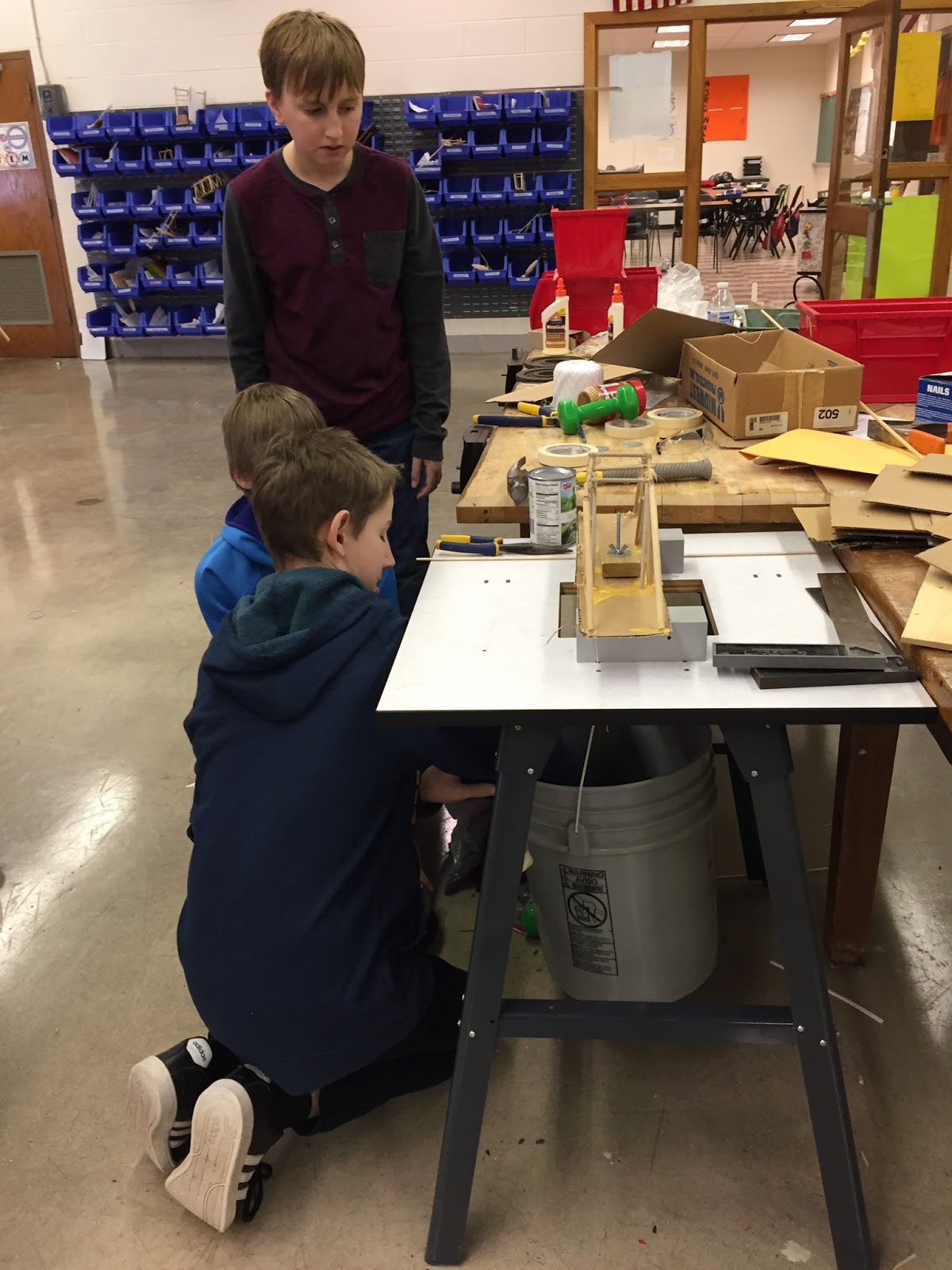
Students in STEM, with Mr. Yopp, making final adjustments to their bridges prior to competing.


Students in PE working through circuit training with Mr. Nelson.

Girls volleyball started this past week!

Ms. Pelnar's classroom really shows strong differentiation when students are all working through different projects, at their pace, and gaining formative feedback from Ms. Pelnar throughout each piece!  Patrick drew that free hand!


Bridge challenge took place this week in STEM with Mr. Yopp.  Each class competed against their own class to see which bridge was able sustain proper function while holding the most weight.  The winner for each class then went up against each other within the grade level.  Then... the 7th grade winner and 8th grade winner challenged each other... however, it is "to be continued" as both held 100 pounds and more weights needed to be retrieved to continue!  Pictured is the strongest 7th grade bridge!  Crazy awesome job!!!