domingo, 17 de enero de 2021

January 16, 2021


KUDOS!  
  • Thank you to all staff who were willing to allow the 8th graders to come into your classrooms and spaces for the Underground Railroad simulation with Stephanie Rummler!  It was great to see the students so engaged and to see your support throughout!  
  • Thank you to our 6-8 BLT team for your open conversations and collaboration when it comes to planning for our systems, culture, and environment within the new 6-8 building!  
    • One large decision the team decided on was to keep grade level wings:  6th, 7th, 8th.  The 6th graders will be the wing on the upper level closest to the office area.  7th will also be on the upper level above 8th grade.  8th grade, therefore, will be the academic wing on the lower level!  
  • Kudos to Eric Sulik, Ryan Hoffman, Jon Nelson, Hans Block, and Jennifer Pelnar for your assistance with determining additional equipment needs within STEM, Art, and Wellness/Fitness Center for the new 6-8 spaces!  
Article:  In lieu of an article this week I thought it would be fitting to read and reflect on some quotes as Monday, January 18th is Dr. Martin Luther King Day.  As we continue to check and find our blindspots, notice our biases, and work to not cast judgement on others our students need us.  They need us to speak up and out, to acknowledge when words or actions can be hurtful to others.  As we begin this week which of these quotes from Dr. Martin Luther King speaks to you?  


Information/Reminders
  • Elective Teachers:  
    • In preparation for the 6-8 course selections we need to present all of the new course offerings/proposals to the board for approval.  The set date for the presentation is February 8, therefore, all approval forms need to be shared and sent to me by Monday, February 1 so that I can put them together.  
    • HERE is the document you need to complete for each course that is new.  If the course has all the same content within it that has been taught in the past it does not need to go to the board.  
      • This document is intentionally "view only".  Simply make a copy, title your new course Google Document like below:  
        • New 6-8 Course (Course Name) 
    • The plan is also to update the board at this time in regards to 6-8 scheduling in general.  
  • Monday, January 18 - K-5 District Essential Skills 
    • Just keeping you in the loop!  Our K-5 team will be looking through our Social Studies Essential Skills in preparation for the following week where they will be hearing from two different curriculum companies to start the process of a social studies K-5 adoption.  
  • Wednesday, January 20 - Burlington Connected Staff
    • Staff teaching a section we will be having a Zoom meeting this Wednesday from 10:30-11:00 to ensure everyone is on the same page, answer any questions, etc!  
    • HERE is the schedule & information shared with families for Burlington Connected.  
    • HERE is what our staff are using to organize things for the start so that all of their emails, Google Classroom Links, etc are all in one place for students who are participating.  
  • Wednesday, January 20 - BLT 6-8 Planning from 12:00-1:00 
    • We will be meeting via Zoom again to continue our discussions about systemic and cultural decisions when it comes to how the 6-8 students and staff will function within the new building.  
    • The zoom link and invite has already been shared with BLT members!
Looking ahead:  
  • Thursday, January 28 - Parent/Teacher Conferences from 4:00-6:00
    • BLT asked that conferences shift from 3:30 start to 4:00 start like we usually do.  Therefore, conferences on the 28th will be from 4:00-6:00.  I sent an invite to everyone already along with a document to track who you are having attend conferences.  Please make sure you are working on scheduling these starting this week!  
  • Friday, February 12 - 8:00-4:00 Inservice Day 
    • ALL staff (certified & non-certified) are asked to be in attendance from 8:00-11:30.  Non-certified staff, you have hours for the 12th on your return to work notices but they were subject to change.  Therefore, wanting you to know the hours shifted a bit!  
    • Certified staff your work day is 8:00-4:00!  
    • More details as to what will be taking place when will come in the upcoming weeks!
Pictures from this past week! 
Scott Staude working, at one of the new whiteboard tables that will be in all academic classrooms, with a student to check his understanding of scale factor.  


Briana Harris also taking advantage of the whiteboard table to check for understanding of the difference between finding the perimeter versus the area of a given space.  

Students in Mike Jones's and Amanda Thate's 8th grade math class working together on a pixel graphic by combining like terms.  

Students in Sue Whittaker's 8th grade math class taking a formative assessment on two subskills.  Notice the intentional use of the two rubrics at the top of the formative assessment to show success criteria to students and for ease of assessing for the teacher.  


8th grade band students collaborating and providing feedback to each other while Dustan Eckmann was working one on one to provide feedback to other students playing in the practice rooms.  

8th graders in science class with Donna Sturdevant and Vicky Leuck working to determine the speed of waves by using the wavelength and frequency.  


Images taken this week of the new 6-8 building!  The first one is the ceiling in the commons area - they are currently painting the beams in the space black.  

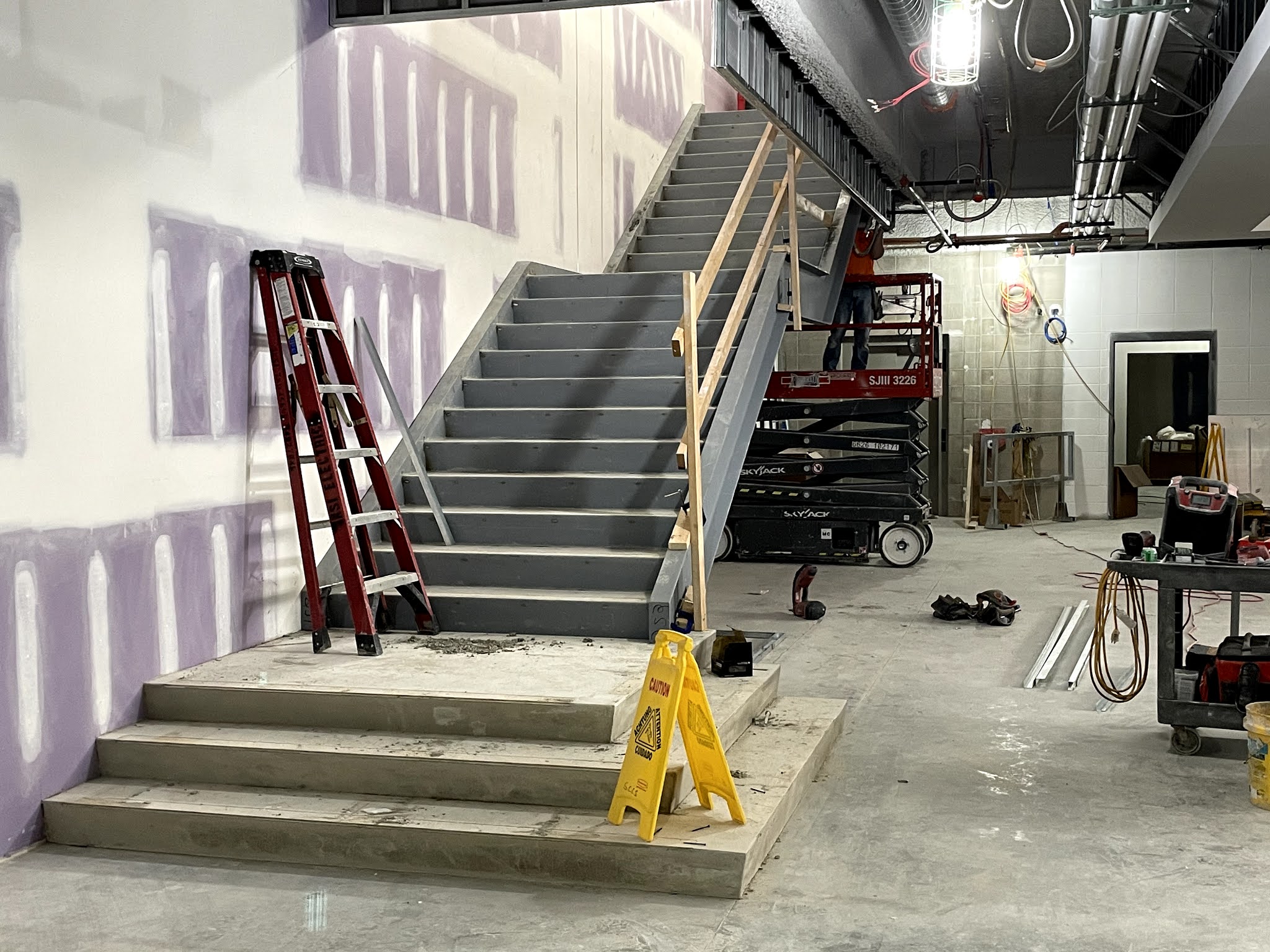
Stairs on both sides of the commons area are in!


Glass has been installed in the 3D printing room!

Tile work has been taking place within all the bathrooms and wall areas where bubblers will be throughout!


Cabinetry being installed in one of the special education/intervention offices for an academic wing.


Glass is in within certain areas of the LMC!

Check out this staff lounge!  It is HUGE!!!  There will be a lot of potlucks and staff culture building happening in this space!


Garage doors are fairly hidden when they are up as they go behind the dropped ceiling!

Commons view again!  

Staff work room in the main office area!  The first picture shows the staff mailboxes, microwaves, fridge, space, etc.  


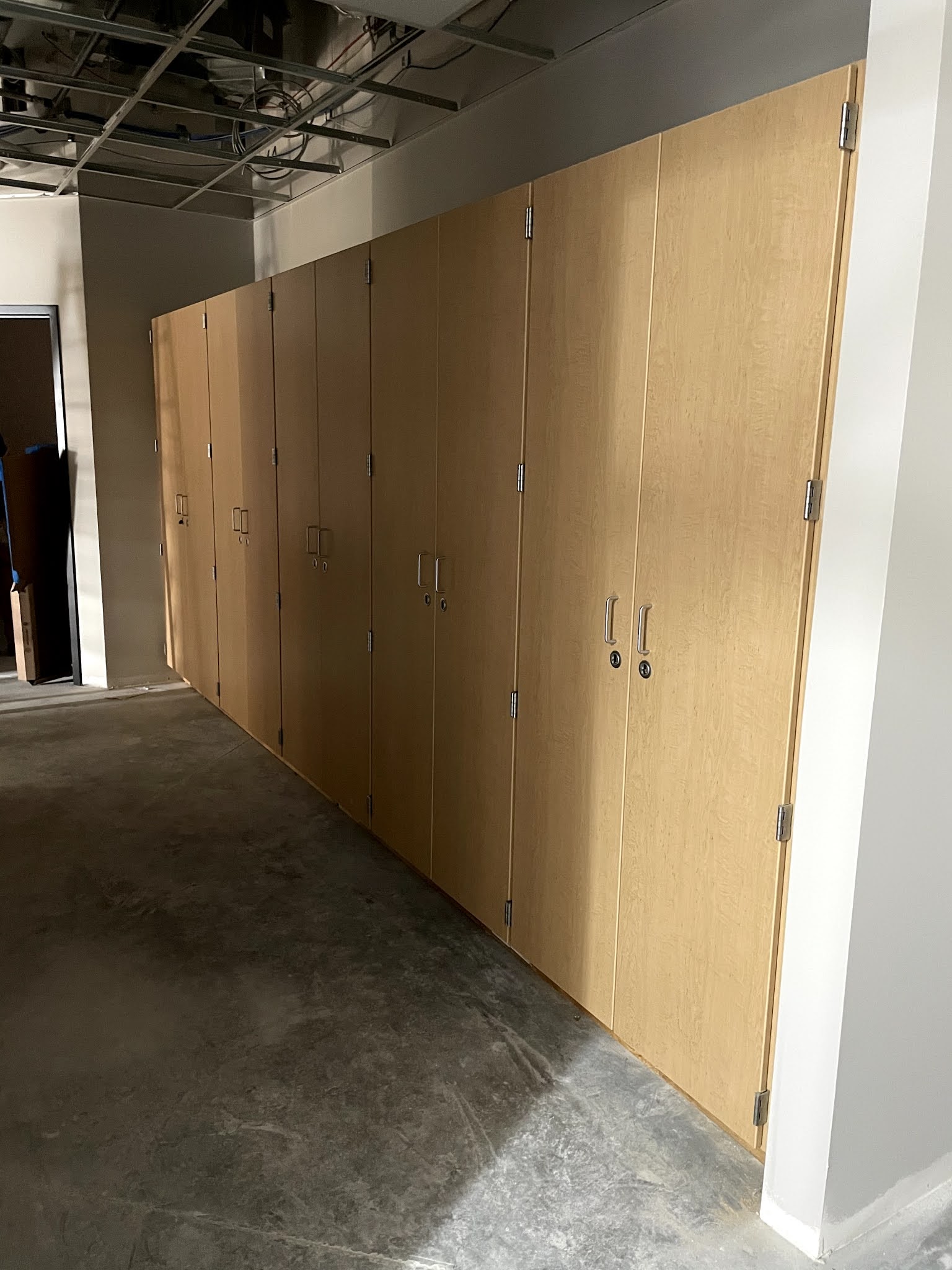
Large cabinets along the wall in the main office area leading into the work room space!

New door from the Life Skills room into the Sensory Room!

View from within a Flex room in an academic pod.  Flex rooms are the medium sized classrooms.

What all classroom doors look like.

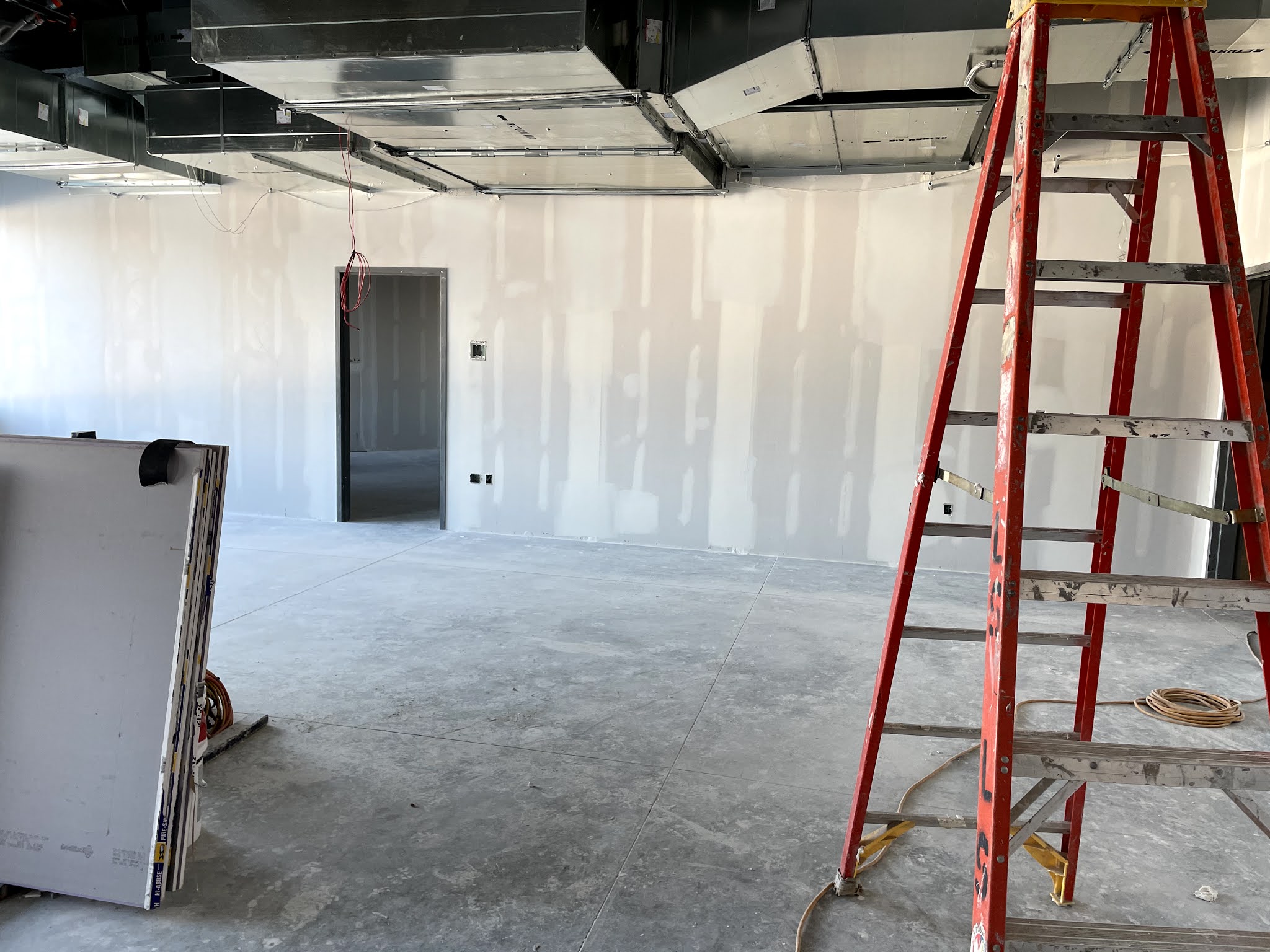
Interior of an academic space flowing into another academic space.  

Visibility from the classroom into the shared hallway space!


16 foot sliding glass door that also serves as a huge whiteboard!

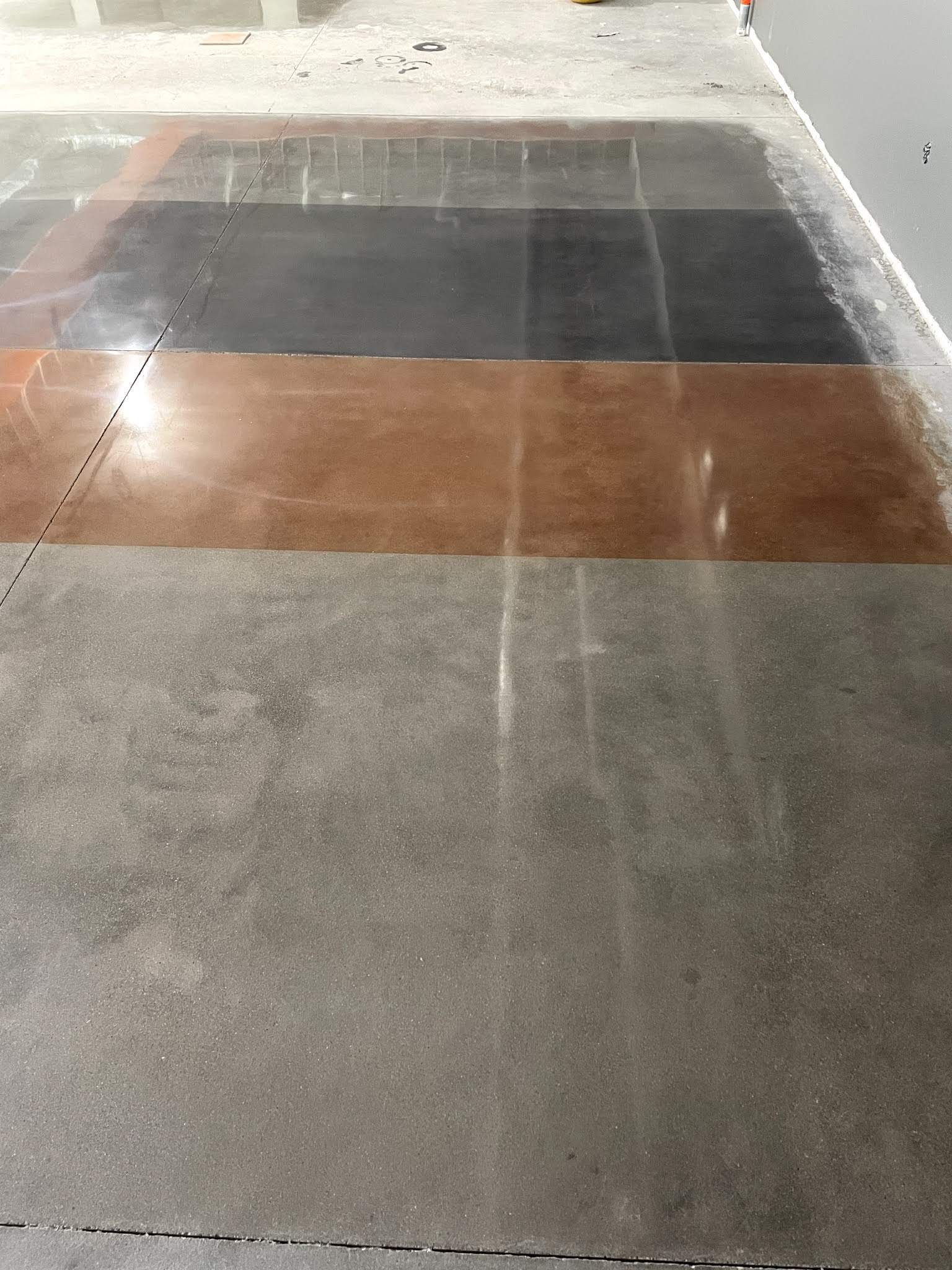
Stained concrete samples... 


domingo, 10 de enero de 2021

January 11, 2021


KUDOS!  

  • Thank you all for your flexibility and assistance with the start of semester 2 as we had changes to student schedules, the addition of new students, and the addition of the virtual sections - which we are calling Burlington Connected.  We really appreciate everyone helping notice little tweaks or adjustments that are needed and communicating those with either Steve, Annie, or myself.  
  • Kudos to Hans Block for his willingness to each grades 3-4 first semester and the first week of semester 2!  Starting January 11 he is with Karcher students and staff full time!  
    • Therefore, those who had a duty to assist in PE can now remain in your ALL sections.  
  • Thank you to Stephanie Rummler (reg ed), Jon Nelson (elective), Melissa Miskell (SPED), & Michele Pulera (support staff) who are all part of our 6-8 team for their willingness to participate in the Payne & Frazier equity training we are engaging in as a school district!  This is an additional training outside of the National Equity Project.  We have had another team engaging with Payne & Frazier already, this will be the second group of staff members participating with them!  The training consists of five 3 hour trainings starting in January and running through May.  Thank you to those listed above for their willingness to participate and be a Goose!  
  • Please welcome Alexis Dahlberg, new student teacher who joined out team this past Wednesday!  She will be student teaching with Stephanie Rummler and will be with us for the duration of the semester!  She comes to us from Concordia University and is very excited to be working with Stephanie and our team!  So... if you see a person following Stephanie around... it probably is Alexis!  
    • Welcome Alexis!  
Article:  This article really emphasizes the importance of Essential Skills and the use of iTime for reading and math!  

Acceleration, not remediation: Lessons from the field

David Steiner / Simaran Bakshi

6.26.2020


David Steiner:

Across the country, preparation is underway for the new school year, with clearly justified concerns over such matters as transport to school, temperature checks and social distancing, the mental and emotional wellbeing of students and teachers, and the possibility of having to combine face-to-face with online learning in a variety of different models.


In the midst of so many challenges, school leaders are also dealing with the almost certain fact that students will have learned and retained considerably less in their 2019–2020 school year than is normally the case. NWEA has attempted to quantify the combination of the usual “summer melt” (what students ordinarily forget over the summer holiday) with the fact that they will have learned much less from online teaching or working with reading packets than had they attended school: “In mathematics, students are likely to show much smaller learning gains, returning with less than 50 percent of the learning gains and in some grades”.


These learning losses are not only large, but are distributed differently across socioeconomic groups. We know that low-income students have had far less access to internet accessibility and the hardware required to access on-line instruction, and are thus likely to have been even harder hit during the Covid-19 crisis. Since such students were far more likely to be academically behind their more privileged peers before Covid-19, they will, in comparative terms, be even further below grade level when they return to school.


In these circumstances, schools may be tempted to focus on the need to” remediate” their students—indeed, to do so more than ever before. Remediation in the United States has traditionally meant that teachers try to provide students whose work is deemed “below grade level” with the material that they had not learned the first time around. Often this is called “meeting students where they are.”


This well-intentioned strategy sounds like common sense. But as I have suggested elsewhere, there is strong evidence that this approach just doesn’t work. It is deeply discouraging to students, and in most cases, simply locks them into a permanent and debilitating learning gap. Instead, in that article, my co-author Daniel Weisberg and I advocate for accelerating rather than remediating.


But what does acceleration look like in practice? One way to answer this is to look at schools that effectively accelerate their students’ learning, every day, every year. Wayman Academy of the Arts in Jacksonville, Florida, is such a place. And what follows is a first-hand account from its principal, Simaran Bakshi, one of Florida’s TaxWatch Principal Leadership Award winners for 2020, who explains how the school does this.


Simaran Bakshi:

When I became principal of Wayman Academy in 2013, it was a low-performing charter school in the poorest neighborhood of Jacksonville, surrounded by other low-performing schools. More than 90 percent of the students performed one or two years below grade level. Few parents were involved in school life. There was a chronic teacher shortage because of the neighborhood’s reputation and the school’s lack of retirement benefits. My charges were simply to keep the school open and not receive another “F” on Florida’s school rating calculation, which is a combination of students’ academic proficiency and growth.


Fast forward to three years later, and the school’s grade had improved to a “B.” Then, in each of the following four years, from 2015 to 2019, Wayman outperformed every school in the district with similar demographics and earned a “high-performing status” from the Florida State Department of Education in 2019, and is now an “A” school.


How did it happen?


My motto has always been “keep it simple,” in both my personal and professional life. In the world of K–12 education, we love to make things complex—and low performance almost inevitably results. Complexity allows teachers and school leaders to claim that they are “doing more,” while the lines of real responsibility in fact become hopelessly blurred, and the overarching “system” becomes the scapegoat for the results. Overcomplicating things especially overwhelms those teachers and students who are already struggling.


So as the principal at Wayman, I have been combatting complexity in three ways. First, I focus relentlessly on clear, effective instruction. We provide teachers with the right kind of knowledge, tools, and professional development that lead to teaching practices that work. We emphasize mastery of simple, familiar practices that research has found to have the most significant impact on achievement. And professional development is not just couple of sit-down sessions. Teachers train one another, exchange skill-sets, and receive constant feedback from our Leadership Team. This helps us create a culture of high expectations for students and teachers alike.


Second, we accelerate rather than remediate. Teachers do not water down curricula for our struggling students. Instead, we focus on expediting their growth and filling in any gaps in knowledge or skills, all while teaching them grade-appropriate content on a daily basis.

One of the ways we fill these gaps is with Response to Intervention (RTI) time, which occurs outside of the regular school day, every morning. Every staff member in the school is assigned to teach a common skill or standard, under teachers’ supervision, to a group of students who are struggling in that area. Students join different RTI groups as necessary throughout the year based on their progress and needs. This helps us to stay focused on grade-level content during school hours and move everyone forward on the same learning timelines.


Third, we limit assessments to those that give us useful information about our students’ strengths and weaknesses. The assessments are carefully planned at the beginning of the school year, and instructional time is not compromised. For us, this means administering three formative computerized tests each year that monitor student learning and allow our teachers to better tailor their instruction; four growth-monitoring assessments each year to measure how much progress students have made in set amounts of time; and weekly exams to determine how close our pupils are to grade level.


Here’s how this works in two true-to-life classrooms at Wayman Academy, one each in math and English language arts.


Ms. Smith, fifth-grade math: Her first lesson to her class of twenty-two students was on adding unlike fractions. Our diagnostic assessment data showed that twelve of the children were at a third-grade level on that skill—two years behind. Ms. Smith started the lesson by teaching the fifth-grade concept to the whole class. She then had the class work on fully planned, differentiated independent work that was tailored to each students’ mastery of the prerequisite skills—skills meant to be taught in lower grades—that they’d need to understand the new concept. Struggling students had various gaps: some struggled with halves, for example, and some with breaking fractions into smaller units.


Ms. Smith did not go back to teaching third-grade work for multiple days, as it would have left the entire class behind. Instead, for each day’s fifth-grade-level lesson, she focused on filling the gaps that prevented students from grasping it. And then she used RTI hours for those who needed more help. Differentiation in her classroom, however, was relevant to what was being taught that day, so that students could follow along and soon catch up with their on-grade-level peers. The objective of the lesson was applicable to all students. She did not focus on filling the years’ worth of gaps at a slow speed by moving backwards. She pulled the students up to grade-level faster by keeping the focus only on fractions. The resulting data showed that the whole class mastered unlike fractions within the specified time.


This is a daily scenario in Ms. Smith’s class, and the data support her method of teaching. This teacher’s students have outperformed those in the best schools in the district—not just in growth, but also in proficiency, for last four years. There are several Ms. Smiths in our school.

Ms. Jones, fourth-grade English language arts: She introduced her class to a lesson on drawing inferences from a text, and the diagnostic results had shown multiple students one or two grade levels behind on that skill.


She introduced the fourth-grade standard, and then broke the students up for independent work or group activities. Her students were required to read a text, note specific details, and then synthesize them to achieve new understanding. The work was differentiated for various ability groups, but crucially, every child read the same text. The guided groups that Ms. Jones met with were based on the prerequisites required to understand what it meant to infer something. Ms. Jones helped her students slow down and list the important, relevant details on graphic organizers. Then they relied on their background knowledge to make connections, generate predictions, and draw conclusions. Reviewing those “mini-inferences” led to deeper understanding of the text. Finally, that understanding was brought to bear in whole-group discussion.


Since reading requires a broad range of foundational skills, it would have been easy for her to wander into teaching other skill sets instead of staying focused on one. If a student struggled with sounding out a word, for instance, she did not slip into teaching phonics, but rather stayed focused on the progression skills needed for inferencing. The students connected better throughout the lesson, as Ms. Jones kept them within the range of current grade-level skills.

Dealing with students’ wide range of background knowledge and skills when teaching them a new on-grade-level concept is different than simply teaching below-grade-level material. Teachers needs cadence, a rhythm all students can learn in. Explicit planning is the key to help students with learning gaps. It can be done.


At Wayman, i-Ready data over the last four years show consistent progress. At the beginning of the academic year, is not uncommon for only 15 percent of students to be proficient in reading and 20 percent in math. Yet by the end of the year, a full 65 percent or more attain proficiency in reading, and 70 percent do so in math. Tier 3 students, who require the most intensive help to get up to grade level, have a success rate of 95–98 percent of moving up by one grade level or more by the end of the school year.


A school’s performance is directly tied to what we teach and how well we teach it. When we keep it simple by focusing relentlessly on high-level instruction, good things happen. Students accelerate, teachers thrive, and schools shine.


***What we are doing is the RIGHT work! Continue being relentless about what is Essential, hone in on our student data during iTime, and continue using best instructional practices to the best of your abilities given the pandemic (GRR Model). Our BIG THREE are our BIG THREE for a reason! Just keep swimming!!!


Information/Reminders

  • Furniture Selections for Academic Teachers:  
    • There are 19 teachers who have been asked to select the furniture pieces that will be in the 19 Academic Spaces throughout the building.  These, currently, are considered the ELA, Math, Social Studies, and Spanish classrooms.  
    • Here is the link to the items for them to select.  
      • Within the link is the teacher desk option that all staff will have - it comes with three pieces.  The two desk pieces are at BHS - the desk is in Stacey Stoughton's classroom and the adjustable lecture will travel with the TV/iPad/Apple Pen that will be traveling around to each room.  
  • Burlington Connected 
    • Our virtual sections that we are piloting as a different virtual option than JEDI will begin on January 25.  This would be the normal start date for semester 2 for all of our JEDI students.  
    • Those teaching the Burlington Connected sections should currently have no students listed in the designated slot for your virtual section (either an A or B day section).  
    • HERE is the schedule & information shared with families for Burlington Connected.  
    • HERE is what our staff are using to organize things for the start so that all of their emails, Google Classroom Links, etc are all in one place for students who are participating.  
  • Monday, January 11 - District Essential Skills Grading Practices Committee Meeting from 3:45-5:15 via Zoom.  
  • Recess Reminders:  
    • Please remind and assist students with remembering that if they want to go outside they need to be dressed appropriately to do so... snow pants, boots, etc in order to play in the snow!  
  • Wednesday, January 13 - Academic Teachers 
    • Please use some of your time between 10:30-12:00 to finalize your iTime rotations using our iReady data.  
  • 2021-2022 K-5 Teams 
    • Just so you are all aware, all of our K-5 colleagues have been told where they will be teaching for this coming fall.  They have also been asked to determine which partner (within 2 section schools) will be teaching ELA and which one will be focusing on Math.  As a district we feel it is important to have a bit more of a focus area for all teachers to spend time understanding, especially at the elementary level where they are currently being asked to know all standards for all subject areas.  Just an FYI... 
  • Thursday, January 28 - Parent/Teacher Conferences from 3:30-5:30
    • Teams have shared their desired date for conferences.  Some shared that there is potential of a volleyball gam on February 11 that would eliminate at least 3 staff members from being able to attend conferences.  
    • We also had some teams request conferences sooner rather than later. 
    • Therefore, we will go with the first option, January 28.  We will be meeting with BLT this Wednesday and will discuss the format for these conferences!  
  • Friday, February 12 - 8:00-4:00 Inservice Day 
    • ALL staff (certified & non-certified) are asked to be in attendance from 8:00-11:30.  Non-certified staff, you have hours for the 12th on your return to work notices but they were subject to change.  Therefore, wanting you to know the hours shifted a bit!  
    • Certified staff your work day is 8:00-4:00!  
    • More details as to what will be taking place when will come in the upcoming weeks!

Picture from this past week!  

Below are a few images from this past week of the academic area that a is above the STEAM wing.  First shows the fixed cabinets, then the carpet is on the classroom floor in the closer classroom in the image, and then the carpet in the flexible space outside the classrooms.  


This is an image standing inside one of the science rooms on the second floor.  The Fitness room is across the way in the image (looks orange in the picture).  Those orange boxes are display cases and benches that face the hallway side overlooking the commons.  

This is an image of the band room as the ceilings are in, long lights between the floating ceiling, instrument storage, and the flooring.  

This is an image of the center music room, choir room.  The orange seen near the ceiling are sound panels.  Similar to the band room the floor and ceilings are complete.  

This is an image from the commons looking at the library (lower level) and science classrooms (upper level).  They are starting to cover the steel to get ready to put the final finished wood over the current wood seen in this image.  

Students in Barb Berezowitz's science class working on understanding how a membrane works, what can pass through it (and not pass), along with how osmosis works!  It is GREAT to see the intentional focus on engaging students in labs and in what would be "normal" in a normal school year.  


Students getting active in PE with Jon Nelson and Hans Block!  


domingo, 3 de enero de 2021

January 3, 2020


Article this week: I thought this was appropriate as we roll into the second half of the 2020-2021 school year!  As a shared in the email, you all amaze me EVERYDAY - because you do what is written below! 

Coping with Change and Uncertainty

Phyllis L. Fagell

How educators can regain a sense of control during these tumultuous times.

Nearly halfway through an unpredictable school year, educators may find the ambiguity of their working lives as distressing as the tangible losses they're experiencing because of the pandemic. In a 2016 study, researchers at University College London found that participants who were told they had a small chance of getting a painful electric shock felt more anxious than those who knew they would be shocked. And in a systematic literature review, sociologists in Germany found that job insecurity can exact as big a toll on mental health as unemployment (Kim & von dem Knesebeck, 2015). Perhaps not surprisingly, a new study published in JAMA revealed that the prevalence of depression symptoms in U.S. adults has tripled since the pandemic began (Ettman et al., 2020).

Educators, in particular, are struggling to maintain an even keel. "We can take guidelines and operationalize a plan, but the greatest variable is [that we are all] human"—unpredictable by nature, says Sarah Sirgo, director of learning, achievement, and administration for Montgomery County Public Schools in Maryland. As schools return to hybrid or in-person instruction, for instance, districts can mandate that students wear masks, but they can't guarantee perfect compliance. And while leaders can implement safety precautions, they can't eliminate all danger or predict how individual teachers will cope with the stress and fear. "One of the biggest challenges is how different people will respond and react to the unknown," adds Jae Lee, principal of Carderock Elementary School in Montgomery County.

As a school counselor, I am aware that everyone from parents to educators to children is feeling the stress of uncertainty. Many parents worry that their child has regressed, withdrawn, or disengaged from school. Educators have rapidly acquired new instructional delivery methods, and some are balancing both in-person and remote instruction. Even teachers with decades of experience feel like they're back in year one, and educators across the country are on the receiving end of a steady stream of demoralizing criticism. Meanwhile, emotions are contagious, and children are absorbing all the ambient anxiety.

Amid all this, how can we regain a sense of control? Based on my research and experience, I have identified six ways that educators can cope and be a reassuring source of strength for students when the only constant right now is change and uncertainty.

1. Reframe your personal narrative.

"The linear life is dead," says Bruce Feiler, author of Life Is in the Transitions: Mastering Change at Any Age(Penguin Press, 2020). His data show that people go through three to five "lifequakes," massive life changes with aftershocks that can last five years or more. Everyone hits bumps in the road, he explained to me, but this is the first time the entire planet is experiencing a lifequake simultaneously.

Given the current pandemic, it's easy to sink into pessimism, question others' judgment, or focus on what we've lost, but it's far more productive to alter our mindset and recognize that peaks can't exist without valleys. When we let go of preconceived ideas about what life should look like, we have an easier time self-regulating our emotions.

Rewrite the narrative, casting yourself as the hero—as someone who discovers their strength because of the pandemic. As you frame your story internally, focus on the skills you're acquiring, such as flexibility and self-compassion. Boosting resilience may represent the upside to the pandemic, Feiler points out. "I believe—as scary and sad as it is—we're going to make a lot of calluses and forge a lot of transition-management skills."

2. Prune and preserve relationships.

In times of stress, we have fewer reserves. Uncertainty feeds anxiety, fear, and anger—emotions that hinder the ability to read social cues and adopt someone else's perspective. We are also more susceptible to others' negativity. To sustain stamina, curate your social network. Limit interactions with friends and colleagues who drain or deplete you and protect relationships with the people you've come to trust and who are engaged in this crisis with you.

This can be challenging in times of stress, when people are not at their peak and may be more easily provoked. Following a series of negative interactions with frustrated parents, for example, a trusted administrator may exhibit less patience with a teacher. To limit misunderstandings, know your own triggers, whether that's ruminating about an outcome you can't alter, spending hours with someone who complains incessantly, skipping your morning run, or "doomscrolling" through grim newsfeeds.

Recognize that social distancing can also heighten sensitivity. "One of the reasons why this is hard for everyone—hard for me—is that before, we were getting all this positive energy from daily interactions and reaffirming relationships," notes Lee. He recently had to reassure a staff member who called him and said, "Hey, Jae, I want to make sure you're not mad at me."

Even when educators are physically together, it's harder to accurately interpret someone's tone through a mask. We need facial expressions to decipher emotions in ordinary times, let alone in the middle of a pandemic. "Our nervous systems get activated when we feel threatened, and we can't access our prefrontal capacity as well," explains psychologist Tina Bryson, coauthor of The Whole-Brain Child (Bantam, 2012). Before you react with a strong emotion, take a deep breath and consider whether you're likely to elicit the desired outcome. Lashing out in anger or placing blame tends to be divisive and counterproductive. As the pandemic has illustrated, we're stronger when we work together.

"I hope we all can show a little grace and resist the inclination to be swept up in alarm," notes Sirgo. As one of the officials leading the design and recovery work in her district—as well as a working parent—she knows that everyone is experiencing angst and frustration. "When I think about extending grace, the following things come to mind," she told me. We must

seek to understand and ask questions before reaching conclusions; assume positive intention and the supposition that people are trying to make things work and giving it their best; use language and messages, particularly in email, to communicate in ways that are clear and kind; and be deliberate about recognizing our own stress and anxiety and not placing that on others with frustration and short-tempered reactions.

3. Build community and foster collegiality.

Kingswood College, a K–12 school in Victoria, Australia, is several months ahead (pandemic-wise) of schools in the United States. The school made an initial shift to remote learning, then transitioned to socially distanced, face-to-face instruction, and then—when COVID-19 infection rates began to rise again—returned to distance learning. Adam Somes, head of Kingswood's middle school, told me that staff members continue to take the disruptions in stride, a "rare feat" he attributes to "communication, connection, and community."

Administrators at his school are transparent and honest and have a "we can do this" attitude, he explains. They consistently underscore the importance of optimism, resilience, and being nimble. The entire community—staff and their families, students, and caregivers—participates in online wellness activities such as fitness bingo. 

Bellview Elementary School in Pensacola, Florida, is taking a similarly intentional approach this year. The school's staff recently turned over by 30 percent, in part because of challenges specific to COVID-19, says Nathan Maynard, coauthor of Hacking School Discipline (Times 10 Publications, 2019). Maynard has been working with Bellview's principal to improve school culture during the pandemic, he told me over the phone, by incorporating more relationship-building strategies among colleagues. For example, he says, "Staff are doing virtual and in-person check-in circles to support each other, to integrate new staff, and to proactively address any issues that might arise."

Schools can also use a "tap in/tap out" system like the one at Fall-Hamilton Elementary School in Nashville, Tennessee (Berger, 2018). The principal there adopted the approach to encourage teachers to call on their peers when they need to take a short break or step back from a tense situation. Instead of losing their cool, they can leave the classroom and take a breath while a designated colleague steps in. Educators in virtual environments could design a similar system: They could partner with a teacher who has a different schedule and exchange phone numbers and links to one another's virtual classes.

4. Be specific when naming emotions.

When we're able to label emotions with specificity, we can take steps to manage them. If you simply feel overwhelmed, you might get stuck. But if you know that you're exhausted from worrying all night, or that you're resentful that you're too busy helping others to find time to exercise, you can work to prioritize better sleep and self-care habits.

Once you've pinpointed the feeling or concern, ask yourself, "Does worrying about this help me or get in my way?" Make an effort to extinguish defeatist self-talk. If you're telling yourself "I'm miserable," try reframing that as "I'm sad now." If you're thinking "This is too much for me," try saying, "I can handle tough stuff."

There are four types of grief, and nearly everyone is experiencing two or three of them right now, says psychologist Catherine Steiner-Adair, author of The Big Disconnect (Harper, 2014). In a recent conversation, she explained to me that there is ambiguous grief, "which is free-floating—the loss of summer, the pervasive sense that we've lost so much." The opposite of ambiguous grief is acute grief. "That could be not being able to pay rent or a partner getting furloughed." A third type is anticipatory grief. "What will school be like? How many hours will I be expected to be in a Zoom classroom? How will I manage distance learning with my own children? Will I get in trouble or lose my job if kids don't show up?"

Many individuals are also experiencing moral outrage grief—the fourth type—which is a sadness for what's happening in the country and the world right now. As she explains, "You ask people, "How are you?" and there's this hesitancy [in their response]."

Educators can't vanquish such grief, but as with any emotion, they can "name it to tame it." In other words, they can develop a game plan, whether they reach out to a friend, take a mental health day, or see a therapist.

5. Exercise agency.

It's easy to feel powerless in the face of a pandemic, so focus on what you can do to improve your situation. That could mean reaching out to human resources to inquire about leave or child-care options, contacting an employee assistance program about teletherapy resources, incorporating movement or relaxation practices into your day, or signing up for school or district-sponsored professional development or psychoeducational programs. For example, Christina Connolly, the Montgomery County district's director of psychological services, recently worked with colleagues to create "Waymaking," a set of videos for staff and families covering everything from stress management to the impact of racism on mental health.1 

If you're working in a school building, you can take steps to mitigate risk, such as wearing a mask and washing your hands. "It's important to remember that SARS-CoV-2 is transmitted via the respiratory tract and largely through lengthy person-to-person interactions," says Tim Lahey, infectious diseases physician and professor of medicine at the University of Vermont Medical Center. "That means you can rank teacher-student interactions along a gradient of risk. A quick pat on the shoulder or tousle of the hair by a teacher standing briefly by the student's side is extremely low risk," he told me, while "interacting face-to-face or close-up for longer periods of time raises the ante."

You can also strive to establish healthy boundaries, such as setting personal policies around when your workday begins and ends, when you turn off the computer, and when you stop returning emails.

6. If you can't fix it, aim for acceptance.

There are many facets of the pandemic that are out of everyone's control. You can't unilaterally determine whether your school—or your child's school—operates virtually or in person. You can't guarantee you'll reach every student, and you can't eradicate tough emotions. In fact, you might feel worse if you try to push your pain away. As Carl Jung famously said, "What you resist persists."

Acceptance doesn't mean that you like the current reality; it just means you stop fighting it. It can take awhile to reach this point, but if you stop trying to fix things you can't change, you can then devote your energy to coping with disappointment and unmet expectations. You might even be able to identify a silver lining—or at least some shades of gray. For instance, virtual learning has given principals an opportunity to focus more on instruction, Sirgo says. "Think about the things that can often be distractions that principals no longer have to do—office referrals, lunch and recess, sub coverage, in-person evening events," she explains. As her district moved through the initial stages of planning a return, "principals found ways to look at the fall diagnostic data, talk with teachers about what they were seeing instructionally, and lead more directed conversations with staff about student learning and well-being."

If acceptance is too lofty a goal, try projecting into the distant future. Researchers at the University of California at Berkeley found that when people can imagine how they'll interpret an upsetting event many years later, they experience less anxiety, sadness, hurt, and anger (Bruehlman-Senecal & Ayduk, 2015). This type of "temporal distancing" can help educators internalize the idea that distressing experiences aren't permanent. You don't want to make rash, long-term decisions because of your passing negative emotions.

Weary But Unwavering

While educators didn't choose to work with children through a screen or from a distance, they are choosing to work tirelessly to reassure, connect, help, and teach. "I'd be lying if I said I am not weary right now," says Tara Christie Kinsey, head of The Hewitt School in New York City. "But when I consider why and for whom I do what I do, I remember what a blessing it is to be an educator, what an honor it is to serve, and what an opportunity we have to shape our world for the better. One child at a time."


We got this!

Which of these 6 coping strategies are you wanting to focus on for the start of 2nd semester?  


Information/Reminders:  

  • Term 3 schedules: 
    • We did our best to balance class sizes again for the start of term 3.  Our goal was for classes to be under 15 students per section.  
    • We moved all students out of our virtual sections so that students start term 3 in their "new" classes.  
      • The virtual sections will start instruction on Monday, January 25.  Use this time (between now and then) to plan!
    • All of our JEDI or returning to in-person instruction students have also been added to everyone's sections.  
    • An email will go out today to families to check Skyward as their student's schedule may be adjusted.  
  • Monday-Friday, January 4-8 - This is a reminder that there are Advisory Lessons posted on the Karcher Calendar for this week!  Thank you Jon Nelson and Eric Sulik for your efforts and time spent putting this together!  
  • Monday, January 11 - Friday, January 22 - Last iTime rotation like term 2.  Starting on Monday, January 25th grade level teams have worked to come up with a plan on how you are going to infuse the iReady Winter Diagnostic Data to assist with accelerating student growth as we move into term 3.  
    • Team leaders:  Please put your plans in THIS document so we know the rotations/plans for iTime.  
  • Wednesday, January 6 - Grades for term 2 should be posted by 3:30!  
  • Friday, January 8 - Grades will be accessible on Family Access starting Friday - please let families know that.  
  • Monday, January 11 - District Essential Skill Committee (via Zoom) from 3:45-5:15 to continue our conversation about Grading Practices.  
  • BLT Members... Note two additional meetings have been added to the calendar from 12:00 - 1:00 so that our 6th grade team members can attend (January 13 and 20).  We may need more of these but will start with two!  The focus will be on 6-8 needs as we move into the time frame of students selecting courses for the 2021-2022 school year!